Saturday, July 20, 2024

Col. James Piper, 1856

        ©  Kathy Duncan, 2024

One newspaper clipping from the 1908 Mena Weekly of Mena, Arkansas, recounts the contents of a defunct newspaper from Bethesda Springs, Arkansas, in which James S. Piper is mentioned. The information that he served in the Mexican War, was married to a woman named Mary Ann, and lived near Mena, leaves no doubt that this is the same James S. Piper who I am researching. However, the notation that he was "formerly a governor of a Central American state" was a headscratcher. He was? Really? 


Then I began finding references to a James S. Piper serving in Nicaragua in the 1850s. Was that what I was looking for? I asked the AP US History teacher for clarification. My question: Why was the U.S. military in Nicaragua in the 1850s? He promptly answered: They weren't. That's the Walker Expedition. Filibusters. With that, I "hit the books" Google style. It turns out, that there is more than one definition for a filibuster, which in this case is an irregular military adventurer, specifically an American engaged in fomenting insurrections in Latin America in the 19th century. Basically, Walker raised a private army, which he marched into Mexico and Central America with the intention of taking them and creating territories that would ultimately be slaveholding areas. He seized control of Nicaragua in 1856 and set himself up as president. 

Enter Capt. James S. Piper.

James S. Piper's presence in Nicaragua spanned only a few months. In fact his time there was so brief, that the newspapers had trouble keeping their information current. Because this was not a U.S. military action, there are no service records to consult. At this point, I don't know when James S. Piper arrived in Nicaragua. He does not seem to have raised a volunteer unit to take with him. 

Notice the Capt. J.C. O'Neal mentioned above James S. Piper's promotion to Lieutenant-Colonel. O'Neal factors in later.


By late April Lt. Col Piper was the acting Governor of the city of Granada. This is, no doubt, what was referred to in the 1908 newspaper clipping. It is also worth noting that this paragraph mentions the ill-fated ship the Cortez which was expected in San Juan del Sur, but was to be rerouted to Panama because of the conflict happening at San Juan del Sur. The actions of Col. E. J. Sanders in that incident were called into question by a writer to a California newspaper. Eventually, the passengers of the Cortez were rerouted to Panama where they disembarked to board a different ship. The Cortez was loaded with volunteers, supplies, and money bound for Walker. While in Panama, the passengers were waiting on shore when a fracas occurred that resulted in them losing their valuables and luggage and the lives of thirty members of their party.  


By April 30, James S. Piper had been promoted to Colonel.
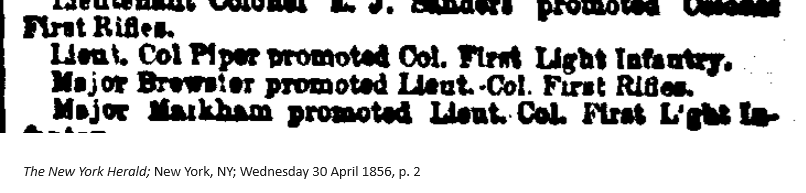


In June 1856, another U.S. paper also reported Lt. Col. Piper's promotion to Colonel. This announcement arrived in the States very late since Piper had probably resigned his commission a few weeks prior to this. Note that Lt. Col. E. J. Sanders was also promoted to Colonel at about the same time. He had been in Nicaragua since at least the beginning of 1856, so Piper may have risen the ranks faster. 


This dated letter from Virgin Bay, written on 30 April 1856, exactly pinpoints Col. James S. Piper's activities. Note that the first paragraph also places Col. E. J. Sanders at Virgin Bay at the same time.


What the newspaper clipping does not report is that something happened between Piper and Sanders that Piper found so egregious that he challenged Col. E. J. Sanders to a duel. Both men had large personalities and were unlikely to back down in a disagreement. Remember, just two years before, James S. Piper was willing to go a few rounds over house numbers.

This appears in Kurt A. Sanftleben's 2021 catalog:

"J. C. O’Neal was also involved in a duel while in Nicaragua. There is a letter in the archive in which he, while acting as a second for Col E. J. Sanders, his regimental commander, replied to the second for another colonel as follows: "Sir, On behalf of my friend Col E.J Sanders in answer to a note received by him from Col J.S. Piper.  I beg to have to state that Col Sanders is perfectly willing to, under any satisfaction necessary without further remarks.  I will name the time - ten o'clock tomorrow morning - distance - thirty paces - weapons - Mississippi Rifles - conditions of the fight - to be placed back to back - and fire at the word one, two, three - In expectation of an early answer - yours respectfully, J.C. O'Neal.".   


In his Reminiscences of an Officer of the American Phalanx, James Carson Jameson provided a little more information about the duel: “Colonel Piper and Colonel Sanders threw down the glove at La Virgen, Colonel Piper, I believe, sending the challenge, which permitted Sanders to name the distance and the weapons. He chose rifles, and fixed the distance at five paces [actually 30 paces per O’Neal’s letter], a grim and deadly ultimatum.  'When the proposal was laid before Colonel Piper he declined to accept it, and immediately resigned his commission in the army, and left on the first steamer for the United States.”  

Unfortunately, these accounts don't reveal why Piper was prompted to challenge. At some point, I may add research on Col. E.J. Sanders. I do know that he was a heavy drinker and card player. When he left to join the Confederate army his wife divorced him. He was about to lose his commission because of his drinking when he was captured. 

The New York Herald reported Col. Piper headed for the States on 3 June 1856.


His arrival was reported on 7 June 1856.


The one thing that Col. James S. Piper kept from his experience in Nicaragua was the title of Colonel. He would never be Capt. James S. Piper again.


Sunday, June 2, 2024

Capt. James S. Piper, 1850 - 1855

       ©  Kathy Duncan, 2024

Whenever I am researching someone, I watch for patterns of behavior. So far, what I know about James S. Piper is that he was well educated, wrote long informative letters and kept up a correspondence with family, was not shy about talking to newspaper editors, placed advertisements in newspapers, soldiered as a volunteer, and sought leadership positions. The next few years revealed his occupation as a contractor during peacetime and his political leanings. 

I have yet to find James S. Piper on the 1850 census. However, he had at least one letter waiting for him at the Washington DC post office in the summer of 1850. 


Also, in early 1850, Maryland passed a resolution thanking Capt. James S. Piper and others for their service in the Mexican War. 


In August of 1851, James S. Piper obtained a contract to supply foundation stone for the Capitol expansion in Washington DC. In most announcements, he is referred to as a quarryman of Baltimore, Maryland.


This blueprint of the expansion features the new foundation. 


In late December 1851, Capt J. S. Piper had two letters waiting for him at the Washington DC post office.


In April of 1852, newspaper articles were still noting that James S. Piper of Baltimore had contracted to provide building stone for the Capitol expansion. 


James S. Piper was not just engaged in the Capitol expansion during this period. In 1854 he also contracted to number houses in the Georgetown neighborhood of Washington DC. This particular clipping from the Daily Evening Star of 11 August 1854 specifically refers to him as "Capt. Piper, (who did good duty in the Mexican war,)," which leaves no doubt that the Capt. James S. Piper from Baltimore who served in the Mexican War was the same Capt. Piper who resided in Washington DC during this period. 


Numbering the houses continued over several months. 


The 1855 City Directory for Washington DC listed those contracted in the Capitol expansion. Among them was Captain James S. Piper, who provided stone for the foundations. I suspected for many years that James S. Piper was involved in the Capitol expansion, so it is exciting to have confirmation.


In 1855, James S. Piper was participating in the American Party. 


The American Party was known by several names - The Native American Party and the Know Nothing Party. They were nativists, opposed to immigrants, especially Irish Catholics, who might be allowed to vote in future elections. Note that Capt. James S. Piper is the group secretary, which would have put him in frequent contact with the local newspapers because he was one of the members responsible for publishing meeting notifications. 


Wednesday, May 29, 2024

Capt James S. Piper, 1847 - 1848

      ©  Kathy Duncan, 2024


The beginning of 1847 saw Capt. James S. Piper still leading Company B of the Baltimore Battalion in the Mexican War. On 1 April 1847, the Baltimore Sun published this list of men serving under Piper in Tampico, Mexico. This list is of value since Piper may have provided affidavits for some of these men or may be mentioned in any memoirs they wrote.


By 11 June 1847, Company B was headed back to the States on the brig Columbus. 


This clipping from The Sun on 19 June 1847, seems to be the first time James S. Pipe provided information to a newspaper editor. Throughout his life, he conversed with various editors and had his comments published. This became a pattern of behavior. 


After arriving in New Orleans, Capt. James S. Piper performed the eulogy for Sergeant William H. Hickman of Company F. His words brought some to tears.


It was not until 29 June 1847 that newspapers began reporting that Capt. James S. Piper had been robbed of $200 while in Tampico.


This is the most revealing and heartrending description of the men who returned with Capt. Piper to the U.S. They were sunburnt and emaciated. 


By the end of the year, Capt James S. Piper was offering to prepare the paperwork that his men needed to provide proof of their service so that they could obtain their land warrants or treasury scrip. He was actively trying those who were wounded in battle as well as the widows and orphans of men who had been killed.


It's impossible to know if he was aware of the plight of Mrs. Beacham, the widow of one of his men. An appeal for her was published in November 1846.


In 1848, James S. Piper seems to have made it his mission to assist all veterans of the Mexican War. He also seems to have been earning a little money by advocating for them. Note that he was a resident of Washington DC at this time.


Monday, May 27, 2024

Capt James S. Piper, 1846

     ©  Kathy Duncan, 2024

In honor of Memorial Day, I am kicking off a series of posts about my first cousins' ancestor, James S. Piper, who was a Mexican War veteran. For decades, I only knew that James S. Piper was a Captain in the Mexican War from Baltimore, that he was in Lamar County, Texas by 1880, that his wife was named Mary Ann, and that his descendants had some of his effects, which I remember as being a uniform and some documents that I never saw. 

Over the years, I came across a James S. Piper on the 1860 District of Columbia census who was the same age, was also born in Maryland, and was a contractor but had a different wife and son. There was never enough information to connect the two men. The years rocked by.

Then last fall, my cousin posted a photograph of James S. Piper's Mexican War Veteran medal, which inspired me to take another stab at trying to find more information.


I turned to newspapers, and the floodgates opened. Newspapers allowed me to connect the dots and revealed a man who led a very, very active life.

The newspaper clippings for 1846 provided important family information for James S. Piper.

On 23 May 1846, The Sun, of Baltimore, Maryland, reported that Captain James S. Piper was raising an infantry company and had already recruited 60 men. It's notable that he already has the title of Captain. Was he elected Captain, or was Captain an honorary title that he already had?


Five days later, the Baltimore Daily Commercial, reported that the volunteers had elected James S. Piper as their captain. However, just because this was reported five days later does not mean that he was elected captain between May 23 and May 28. This election may have occurred before the 23rd and was merely reported later.


By June 2nd, Capt. Piper's company was in Washington D.C. where they were to receive their uniforms and equipment.


Even though he was in Washington, D.C., Piper continued to recruit men from Baltimore.


By 24 July 1846, Piper's company was in Brazos Santiago. The American Republican and Baltimore Daily Clipper printed letters written by members of his company. 


On 11 August 1846, the Easton Star of Easton, Maryland published a letter that James S. Piper had sent from the mouth of the Rio Grande to his brother in Washington D. C. Unfortunately, his brother was not named. 


James S. Piper wrote this very lengthy letter from Monterey in October of 1846:


On 6 November, Capt. James S. Piper wrote yet another letter to his brother in Washington D.C., but this time his brother was named: Dr. John R. Piper.


The obituary for Dr. John R. Piper that appeared in the Baltimore Sun on 18 March 1871 revealed that his father, and therefore, Capt. James S. Piper's father was Philip Piper of Baltimore:


The newspaper clippings of 1846 reveal that James S. Piper was a well-educated individual with a penchant for letter writing. I hope that more letters will turn up among his extended family members. 


Sunday, March 31, 2024

John Deloss Brown, Candidate for Sheriff

    ©  Kathy Duncan, 2024

John Deloss Brown of Pike County, Illinois, flirted briefly with running for sheriff in 1880. I was able to positively identify this J.D. Brown as being him based on my knowledge that he had served in the Civil War, was associated with Republicans, and had served as Justice of the Peace for Nixon township.


However, shortly after throwing his hat in the ring, J.D. Brown had a change of heart and withdrew his candidacy. Apparently, he thought he was not known well enough to be successful in his bid. It makes me wonder if someone actively discouraged him. 


Sunday, February 25, 2024

The Dendys and The Fatal Accident

   ©  Kathy Duncan, 2024

This newspaper clipping, reprinted in The Troy Messenger of Troy, Alabama, on 9 March 1876, recounts a horrific accident that happened in Wood County, Texas. The six-year-old daughter of the Dendy family was crushed to death in a hack accident while the family was returning home from church. My Dendy great-great grandparents moved from near Troy, Alabama to Wood County, Texas, and lived there in the 1870s, but was this my family? My great-great-grandfather, James Hogan Dendy, had a brother who also moved from near Troy, Alabama to Wood County, Texas. I finally decided it was time to investigate.


Since this article mentions J.R. Wright and the Alvis family as the other parties involved, I revisited the available records with these individuals in mind. On the 1870 census, J. H. Dendy and his family were living in precinct four of Wood County. Also, in precinct four was J.R. Wright. In 1870, James H Dendy's brother Lawson Dendy was still in Goshen Hill, Pike County, Alabama. 

The 1876 Wood County tax list places J. H. Dendy and Jno R. Write in precinct four. Lawson Dendy was not present on the 1876 list. By 1877, Lawson Dendy was in Wood County along with his brother James H. Dendy, but the Wood County records no longer divided tax records up by precinct, so it is impossible to know which precinct Lawson was in. In November of 1877, James Hogan Dendy and wife Lydia Ann Pugh sold their property in the Antonio Flores survey and moved to Bowie County, Texas. From Bowie County, it would have been impossible to visit very easily with family back in Wood County. That's surprising given that the 1880 census reveals that Lawson Dendy brought their mother Nancy (Williams) Dendy with him to Wood County and that Lydia's sister Hannah (Pugh) Hooks had moved to Wood County. Why did James and Lydia leave Wood County just as other family members were arriving - family they had not lived near in at least six years? 

On the 1880 Wood County, Texas census, J. R. Wright was still living in precinct four, there was an Alvis family in precinct four, and Lydia's sister Hannah Hooks was living in precinct four. Lawson Dendy and family with mother Ann Dendy were in precinct one. 

In comparing family group sheets for James Hogan Dendy and for Lawson Dendy, neither one had a daughter born around 1870 who died or disappeared abruptly. There is a gap in both families for a daughter who could have been born after the last months of 1870 but never appeared on the census.

The current road from Black Oak, Texas to Winnsboro, Texas seems to go near if not through the Antonio Flores survey, where the James H. Dendy family lived. The total distance between Black Oak and Winnsboro is ten miles.

In pondering this problem, I suddenly remembered the mystery photograph from my Dendy great-grandparents' album. 


This is an 1890s copy of three earlier tintypes. These pictures seem to have been taken on the same day since they seem to be sitting in the same chair. One of my cousins found a metal mourning button featuring this identical picture of the man in an old trunk that belonged to my great-grandparents. The question has been which set of great-great-grandparents this photograph portrayed - Dendy or Davis. The man does not resemble my great-great-grandfather, Davis, so he is ruled out. However, my great-great-grandmother Davis had a previous husband who died in the Civil War, and they had a daughter together. However, he died before their daughter reached this age. They could not have all posed in the same chair since he was deceased on the day these portraits were made. 

That puts the spotlight on the Dendys. James Hogan Dendy died in 1892, so a mourning pin made from his picture makes sense. The inclusion of the little girl has always been a question. The Dendys had a daughter born in December 1871. Why wouldn't this photograph have been passed along to her or her family if it was a picture of her? Why make a copy with just one child? Why not include the other children who surely had their pictures made, too? My great-grandfather was born before 1870. There were also other children living at the time these photos were made, why aren't they included in this copy? I now believe that Lydia Ann had this copy made, grouping her deceased husband, herself, and their deceased daughter together in one photo memorial. Or one of the Dendy children had it made for her as a gift. 

There is a picture of a youthful Lydia Ann (Pugh) Dendy that is much clearer than this one. In it, she is wearing a black bead necklace. The photograph of the woman in this group picture is of such a poor quality that it is difficult to positively identify her - although they both had dark hair, worn close to the head.

I'm confident that this is a photograph of the Dendys and their daughter as they appeared in 1874 to 1875. Unless a family Bible is found, the little girl will probably remain nameless. She would have been buried in Wood County, and so far I have not found a tombstone for her online. 

The combination of the newspaper clipping and the photograph shed some light on the mystery of why the Dendys sold out and left Wood County in 1877. Since the clipping recounts that they had been to a "preaching" that fateful day, they would have had to pass the spot in the road where their daughter died every time they went to church. If the church they attended was in the direction of Winnsboro, they would have passed that spot every time they went for supplies. Plus, it would have been the talk of the community for months. I think it must have become unbearable, so they sold out and left their families behind. 

No oral story of this event was passed down in my family. I think it was probably too painful for anyone to speak of. My great-grandfather would have been seven or eight when his little sister was killed, and he would have had a clear memory of this event. If it had happened to a cousin rather than a sister, I think the story would have been recounted.