Showing posts with label Holcomb. Show all posts

Sunday, July 19, 2026

Nathaniel Holcomb - A Clue, 1796

  © Kathy Duncan, 2026

My furthest back Holcomb ancestor is Nathaniel Holcomb, who first appears in the records of Ste Genevieve County, Missouri, in 1805 when he was named in a lawsuit. The problem is trying to track him backward out of Missouri. 

All of Nathaniel's children except one seem to have been born in Missouri. His eldest daughter, Esther Holcomb, seems to have been born elsewhere, and that may be the key to discovering where Nathaniel had been before he came to Missouri.

The 1850 census of Jasper County, Missouri, provides the information that Esther (Holcomb) Jameson was born in Tennessee in about 1796. Even though Esther was the head of the household, there is no way to know if she provided that information or if it was provided by one of her children or a neighbor. 

By 1880, only three of Esther's children were still living. In that year, her daughter Phoebe Caroline (Jameson) McNeill's census record stated that both of her parents had been born in Virginia. Her sister Margaret (Jameson) Pool's census record stated that her father was born in Kentucky and her mother in Missouri. The other living child, Jasper N. Jameson, has not been located in 1880. 

By 1900, only Jasper N. Jameson was still living, but not found on the census. In 1920, Jasper's census record stated that his father was born in Virginia and his mother in Missouri. 

That's a lot of conflicting information. My gut says to trust the census that was taken during Esther's lifetime, but I know from experience that it may not be reliable either. If Esther was born in Tennessee, then Nathaniel Holcomb and his wife were also in Tennessee.

Can a Nathaniel Holcomb be found in Tennessee in the 1790s? Tennessee was created from North Carolina in 1796, so that narrows down the window for a search. We know that Nathaniel Holcomb and family were in Missouri by about 1799 when Enoch Holcomb was born. Using Family Search's full-text search, a Nathaniel Holcomb can be found witnessing a deed in Tennessee in the 1790s. On 9 April 1796, Eli Strickland of "Tennessee County of the Territory of the United States" sold a piece of land to William Milcherson, who was also of "Tennessee County." Eli Strickland sold the land through a power of attorney with Nathaniel Holcomb as a witness to that power of attorney.  The deed is located in the Montgomery County, Tennessee, records, but the land itself seems to have been next door in Robertson County. Prior to statehood, that region was known as "Tennessee County." After statehood, that area was divided into Montgomery and Robertson Counties. Eli Strickland had purchased his Tennessee land as early as 1793. That purchase is filed in Robertson County, Tennessee, but there is no mention of Nathaniel Holcomb in that earlier transaction   

In theory, records for Tennessee County are kept in Robertson County, Tennessee. However, Eli Strickland's land sale, witnessed by Nathaniel Holcomb, is kept in Montgomery County, Tennessee, Record Book A, p. 1.


The Strickland name, of course, is part of Nathaniel Holcomb's FAN group. Titus Strickland of Ste. Genevieve County was the guardian of Nathaniel Holcomb's children after Nathaniel died. There was an Eli Strickland in Ste. Genevieve County during the time period that Nathaniel Holcomb was there. Was he the same Eli Strickland? Eli Strickland, like the Holcombs, was also in Plattin Twp. in Jefferson County, Missouri. 

None of this is conclusive, but it is a clue. If the two Eli Stricklands could be proven to be the same person, then this would be stronger evidence that Nathaniel Holcomb was also in Tennessee County in the 1790s. 


Saturday, February 7, 2026

G. D. Nevill, 1924 Obituary

  ©  Kathy Duncan, 2026 

Take this to heart. Do not give up in your search for information on your ancestors. It's out there, but it may take some time to surface. I've searched for an obituary for my 2x great-grandfather, G. D. Nevill, for decades. I knew it was a fruitless search because the newspaper where he died burned, but I've continued to look. The old Clarksville, Texas newspapers, prior to about 1944, were consigned to the bonfire by the owners of the Clarksville Times years ago. It's a sore spot among the residents who care about Red River County's history. And I admit, it's a sore spot with me, too.
My 2x great-grandfather was named Grandison D. Nevill after his father. Sometimes the name appears as Granderson. However, for most of his life, he was called Granville D. Nevill. I thought it was originally to distinguish him from his father, but in some records his father is called Granville, too. But, I digress. Nevill is spelled a variety of ways in records: Nevill, Neville, Nevil, Nevills, Nevilles, Nevils, Nevels, etc. The full list has to be kept in mind when using databases, like those for newspapears, that require exact spelling.

As luck would have it, Red River County, Texas, borders McCurtain County, Oklahoma, which also had newspapers. Granville's son, Solomon "Bud" Nevill was a real estate agent in Broken Bow, McCurtain County, Oklahoma. When Bud Nevill's father died, and he went to Avery, Texas, for the funeral, the Broken Bow News reported on it on 13 June 1924. 


The paper reported that Granville was injured when "in some way he fell" from the truck his son William "Bill" Granville Neville was driving.

As it turns out, I know how that happened, or at least, I know the Duncan version of what happened. My great-grandmother was Bud Nevill's sister, Susie Duncan of Avery, Texas. My grandfather told me this story several times. Decades later, he still became angry about what happened. My grandfather was seventeen when his grandfather died. He would have heard this discussed at home and probably around town. 

Bill Nevill was driving a truck with his father, Granville, in it. They were in Avery when Bill took a sharp curve by the Methodist Church too fast. That curve is still there. During my childhood, there was a railroad track crossing there as well. My grandfather always said that Bill was driving too fast when he took that curve and threw the old man out of the truck. My grandfather emphasized that they were meeting a horse and wagon, and Bill was driving so fast that he spooked the horse. 

Of the several states that Granville D. Nevill lived in, I know of Tennessee, Arkansas, Oklahoma, and Texas. Were there more??


Every time I take this curve, I think of my great-great-grandfather, Granville D. Nevill, falling from a vehicle and dying from his injuries. 

Granville Nevill was buried in Savannah Cemetery, near Avery, beside his wife, Louisa Rebecca (Walker) Nevill, daughter of John C. and Hannah (Holcomb) Walker. 


Sunday, September 24, 2023

Family Search's Experimental Search Tool - Benajah and Hannah Brown

   ©  Kathy Duncan, 2023

In the later part of July, researchers on Facebook started sharing a link to Family Search's United States Wills and Deeds Experiment Search tool. Family Search's experimental prototypetext tool came with the warning that they made no guarantees regarding the availability of the tool. I think we all took that as a warning that it would be short-lived.  

While it lasted, it was phenomenal, and I am looking forward to it being re-released in its "final" form. The beauty of the search tool was that it ran an every-name search so that it went well beyond the principal parties in a record. It found records that were in unindexed county record books. Most importantly, it shortened the length of time required to wade through records county by county. 

My ancestor, Nathaniel Holcomb's wife, serves as a prime example. Up until now, I could only theorize that her name was probably Hannah. I knew that whatever her name was, she had married Benajah Brown of Ste. Genevieve County, Missouri as her second husband after Nathaniel Holcomb died - which was by 1814.

My previous research indicated that the woman, who was Benajah Brown's wife and Nathaniel Holcomb's widow, was old enough to be the mother of all of Nathaniel Holcomb's children, but I don't know that for a fact.

The experimental search tool pulled up a deed in Ste. Genevieve County from Benajah and Hannah Brown to James Skaggs, the husband of Nathaniel Holcomb's daughter Hannah Holcomb. Hannah Brown is named in the deed and released her dower rights before Robert Jameson, the husband of Nathaniel Holcomb's eldest daughter Esther. This indicates that Hannah was still alive as of 1834 and that she could not write her own name. Of most interest is that it provides the location of their land: the NE 1/4 of the NW 1/4 of sec 29 Twp 39 N Range 7E. 

Click to Enlarge


The next deed record that the experiment search tool located was from Benejah Brown of Newton County, Missouri to John C. Brickey of Ste. Genevieve County, Missouri in 1843. Hannah Brown was not included, which is an indication that she was deceased by 1843. This deed confirmed my theory that Benajah Brown was the elderly man living with his son James Brown in Newton County, Missouri in 1840. This land was located at SE 1/4 of the NW 1/4 of Sec 29, Twp 39N, Range 7E in Ste Genevieve County.

Click to Enlarge


This 1930 Plat Map Book of Ste. Genevieve provides the location Sec 29 Twp 39N Range 7E:


Benajah Brown's land was roughly here:


Sunday, October 3, 2021

Grandison D. Nevill's Teaching Career

       ©  Kathy Duncan, 2021

Before Virgil Nevill died, he was interviewed by a great-nephew about the Nevill family. In that interview, Virgil revealed that when he was a young boy, he had gone on a short trip with his grandfather, Granville D. Nevill [Grandison D. Nevill Jr.], from Avery, Texas to Mt. Pleasant, Texas. During their journey, they supposedly visited the grave of Granville's father, and the old man told his grandson that he had negative feelings for his father because of his parents' divorce, that his father had been a horse trader and harness maker, that he had a quick temper, that he had been a school teacher, and that they had run a freight line together from Mt. Pleasant, Texas to Jefferson, Texas. Virgil also recalled that his grandfather had a brother that he visited in Beaumont, Texas. Over the years, I have been able to document everything except the freight line.  

On the 1880 census in Crawford County, Arkansas, G. D. Nevill Sr's occupation was listed as being a school teacher.

Crawford County, Arkansas 1880


Teaching seemed to have been a fallback profession for Grandison D. Nevill Sr. Something he could do when he was not operating a tannery or farming or too old to do anything else. 

Many years prior to 1880, Grandison D. Nevill can be found in Stoddard County, Missouri when he was involved in a lawsuit against Ransom Ladd. That suit was in the courts from September 1851 to March 1853. This was in the immediate years after Grandison lost his tannery and property in Dickson County, Tennesse, and after the dissolution of his third marriage to Annette Travis. There were no other Nevills living in Stoddard County on the 1850 census, so he was likely the only Nevill in Stoddard County in 1851. 

The following information can be found in S. C. Turnbo's Early School Days Near Bloomfield: 

"In speaking of early day schools in Southeast Mo., Mr. Austin Brown who has lived many years at Peel, Ark. gives this account. "I was 12 years old [when] I received my first schooling. This was in 1847 and we lived near Bloomfield in Stoddard County. The school was taught in a little log hut by a man of the name of Macum. Some of my school mates were Anthony and Daniel Clubb who were brothers and there were 3 or 4 of the teachers sons and nephew of his was also named Macum. When I was 16 years old or in 1851 a man of the name of Neville taught on Delaware Creek 4 miles west of Bloomfield and I went to it. The only names other than myself that I call to mind who attended this school was Susan Chappelle and her brother Leiper. I studied my lessons in Noah Webster's old Blue Back speller and during the first school I got to Baker and the next one I reached the pictures which pleased me well." 

It is reasonable to think that this teacher was Grandison D. Nevill, and it indicates that he was teaching school as early as 1851. 

Then in 1873, a single man by the name of Nevill was teaching in the Black Fork Township of Scott County, Arkansas. Grandison D. Nevill Jr. had married the daughter of John C. Walker and Hannah Holcomb of Scott County, Arkansas around 1867, and they had moved to Titus County, Texas by 1870. They did not stay there long before returning to Arkansas, probably in the vicinity of her family. It is reasonable to think that Grandison D. Nevill Sr was also in the vicinity since he seems to have lived near his son from 1860 on. Grandison Sr. can be found in Sebastian County in 1863, where Grandison Jr's children married years later. Senior can also be found next door to his son in Crawford County, Arkansas in 1880. His exact location in 1870 is currently unknown. This may have been during the period that the Nevills were running a freight line from Mt. Pleasant to Jefferson. 

This description can be found in the book From Memory's Scrapbook: A History of the Early Days of Scott County, Arkansas vol 2 by P.M. Claunts:

"One of the early teachers of Blackfork valley was Prof. Nevills, to whom the writer attended school when a small boy. This was about 1873, not sure about the year. It was taught in a little log house which stood just north of the valley road about one mile west of the John M. Martin Sr. home and on the north side of Blackfork creek. It was made up of all ages and sizes none being larger than the teacher who weighed bout 200. It was a winter term beginning in September and continuing until the following March. Many children, ten or [?] years of age learned their alphabet at this school and the grown-ups all studied the old McGuffey's, a blue-backed speller and the readers from No. 1 and No. 4, and Ray's arithmetic. At intervals during the day he would have the whole school lay their books aside and sing a little sing-song ditty beginning with the words of two letters and continuing to words of three letters, for example: 'Except that I cannot give the tune---' Ba Be bi-biby-bi bo-biby-bi-bo-bu-biby-bi-bo. (One would have to hear it to appreciate it). Another sing-song was the states and capitals. Beginning at Wisconsin, following with the capital repeating each or since each twice; taking in all the states and capitals. This was not so silly as the "Ba's" for we learned these states and their capitals and the writer can yet repeat them in this sing-song way. Special:--(If any of the Waldron readers want this story verified and a sample of the singing, just make an appointment with Judge W.A. Bates and advertise it and you will have an audience and be well entertained for he attended school to this same teacher, at Vise schoolhouse on Jones Creek). The teacher boarded at the R.G. Richmond home and from this home two boys and three girls attended: Jerry, Ben, Lou (who later became Mrs. L.O. Day), Lila who later became Mrs. Bud Gist, and Mollie, who later became Mrs. John Allen and later Mrs. Aikin, the only surviving member of the Richmond family, at this writing. In this school there were bad boys and pranks as is found in modern schools of today. There was one boy in the school who was from a family where the father had died; the widow, in providing pants for the boy, made a pair shorter but no smaller from a pair of the father's trousers and they were supported by a string over one shoulder. This bad boy would be just behind him when he stood up for his spelling lesson as it was called. It was a warm day and the boy had on no coat; when [he] crossed his legs the string slackened and the bad boy from behind with a sharp knife clipped the string and the show started, with the trousers falling to the floor and the boy in his excited effort to pull them up, hobbled himself and fell, all the time making for the door. When he went out at the door he had only one foot in the trousers and was supporting them in his hand. The teacher like the pupils, could not hold himself and announced: 'recess for dinner.'

It was the next day before this boy showed up at school and he never did know the string was cut, but thought it broke."

It is interesting to me to note that years after Grandison D. Nevill Sr was teaching at Black Fork and Vise, Arkansas, his granddaughter Susan Gertrude Nevill married Richard E. Duncan, a nephew of Samuel K. Duncan who became a legal partner with the very same Judge W. A. Bates, who had been a student of Grandison D. Nevill Sr. 

Keywords: G. D. Nevill, G. D. Neville, Granderson D. Nevill, Granderson D. Neville


Tuesday, December 29, 2020

C W Owens, Grandson of Nathaniel Holcomb, 1939

 ©  Kathy Duncan, 2020

Cyrus W. Owens was the son of Phebe A (Holcomb) and James A Owens. Cyrus Owens was born in California in 1865, fifteen years after his grandfather Nathaniel Holcomb left Missouri and settled around Soquel, California.

In 1939, C. W. Owens of San Francisco, California wrote a letter to the editor of The Sentinel in Santa Cruz, California in which he related the arrival of Nathaniel Holcomb in California in 1850 and Nathaniel's adventures in South America in 1866. We also learn about the fate of Nathaniel Holcomb and his son Alfred O. Holcomb.

Cyrus also relates a tidbit about his uncle Isaac Holcomb. This is yet another indication that Isaac was, indeed, a son of Nathaniel Holcomb's. 

It is significant to note that this letter was written long after the time period in which I would expect to read information about the early Holcomb's in a newspaper, so it is not always advantageous to limit a search with a narrow date bracket. Having done as much whole family research as possible, I realized that C. W. Owens was a grandson of my ancestor's Azariah Holcomb's brother, Nathaniel. 


Friday, December 25, 2020

Possible Stafford Connections for Azariah Holcomb's Wife Susan

   ©  Kathy Duncan, 2020

Family tradition holds that Azariah Holcomb's wife Susan was a Stafford. However, to date, no primary documentation has been found to support that.

According to the Holcomb bible, Azariah Holcomb married Susan on 20 April 1819. At that point, Azariah Holcomb was probably living in Ste. Genevieve County, Missouri, and likely married Susan there. 

Many researchers claim without documentation that Susan was the daughter of William Stafford who married Leah Westervelt or Westerfield. Leah (Westerfield) Stafford died in Scott County, Kentucky in 1817. William Stafford died in Kentucky in 1820. It would seem that they did not migrate to Missouri during their lifetimes. If Susan was a daughter of William and Leah Stafford, she would have needed to travel to Missouri with a sibling or other relative, but none of the children attributed to William Stafford seem to have gone to Missouri. I find it difficult to believe that a young woman would have struck out for Missouri on her own in that time period. I think it would be much more beneficial to research Staffords who were in closer proximity to Azariah Holcomb. 

While the household of Azariah Holcomb is not on the 1818 Ste. Genevieve County, Missouri census, the household of Benajah Brown is. Brown had presumably married Hannah Holcomb, widow of Nathaniel Holcomb by 1818 when son James Brown was born. The older, unmarried Holcomb children were likely still living at home in 1818. The household of Noah Stafford was near Benajah Brown in 1818. He had married Sarah Blackwell in Roane County, Tennessee on 5 November 1806. Noah Stafford eventually removed to Crawford County, Missouri. He was born in South Carolina in about 1782, which would make him fourteen years older than Azariah's wife Susan, who was born in 1796 in Kentucky. 

At fourteen years older than Susan, Noah might have been her older brother. Alternately, he could have been a cousin or a young uncle. There were no other Stafford households in Ste Genevieve, but Noah could have been surrounded by married sisters and/or a remarried mother. 

It is not inconceivable that Noah Stafford was born in South Carolina and that his family moved to Kentucky where Susan was born. Then as a young adult, Noah removed to Tenessee before his final move to Missouri. The question is if he had a younger sister with him or a remarried mother, moving in tandem with him. 

The obituary of Noah Stafford's son, Richard Stafford places the Stafford family in Ste. Genevieve County, Missouri as early as 1815 when Richard was born there.


The obituary of Noah Stafford's son Samuel Ellison Stafford indicates that the family was still in Ste Genevieve County, Missouri in 1824 when Samuel was born there. It also indicates that they did not relocate to Crawford County, Missouri until about 1833. 


An additional obituary for Samuel Ellison Stafford names Noah Stafford as his father.


The eldest child that I have found attributed to Noah and Sarah (Blackwell) Stafford is Elizabeth Stafford who was born in Missouri in 1807 or 1808. This would mean that Noah Stafford removed to Missouri almost immediately after his 1806 marriage to Sarah Blackwell. 

Another Stafford married in Roane County, Tennessee, near the time that Noah Stafford married. Thomas Stafford married Rosey Baskin on 22 November 1803 in Roane County, Tennessee. I have not found any additional information on this Thomas Stafford. 

Noah Stafford signed a petition from the [Louisiana] Territory on 9 September 1811 asking for the rights of citizens, essentially, statehood. This was the area of the Missouri Territory. Notable among the other signatures were the names of a John Stafford and Titus Strickland. So far, I have not found any additional information on John Stafford.

To date, I have not been able to make a connection between Noah Stafford and Azariah Holcomb other than proximity. 


Sunday, December 20, 2020

Caroline (Jamison) McNeil Death Notice, 1906

  ©  Kathy Duncan, 2020

By the time Caroline (Jamison) O'Neil died in 1906, her nephew R.W. McMullin had been deceased for three years. However, because of that connection, the Jefferson Democrat published this death notice for her:


Fatima C. (Jameson) England's Missouri Death Notice

 ©  Kathy Duncan, 2020


My hunch is paying off. R.W. McMullin, the editor of the Jefferson Democrat in Hillsboro, Missouri, was publishing tidbits about his extended family.

This death notice is for his aunt Fatima Charlotte (Jameson) England who died in San Benito County, California. This makes me wonder to what extent family correspondence was taking place and where that correspondence is now.


Nathaniel Holcomb Explores the Amazon, 1872

  ©  Kathy Duncan, 2020

Well, be still my heart. Continued poking around has turned up another letter written by Nathaniel Holcomb in 1872, detailing his trip to the Amazon and the conditions there. It was picked up and republished in the Jefferson Democrat of Hillsboro, Missouri, on 21 February 1873 because someone associated with the paper was a relative of Nathaniel's. The question, of course, is who. A quick check of the editorial page reveals that the editor at that time was R.W. McMullin. He was Richard Watson McMullin, the son of John T. and Elizabeth Mariah (Jamison) McMullin. His mother was the daughter of Esther (Holcomb) Jamison, and a niece of the letter writer, Nathaniel Holcomb. It is, of course, convenient for me that R.W. McMullin edited a newspaper. Maybe more family information will come to the surface through that source. 


What I find important about the publication of Nathaniel Holcomb's letter in this Missouri newspaper, is that it reveals that editor R.W. McMullin knew who his relations were and took an interest in them. The letter itself reveals that Nathaniel Holcomb was well educated for his generation. That hints at the educational level of his parents and the possibility that he attended school. 

It is a long letter, so I am going to just clip the beginning and end of it, and then transcribe it below.


October 10th, 1872

Dear Sir: This is the first opportunity I have had of fulfilling my promise.

I left San Francisco the twenty-sixth of December, 1866, and landed in Callao, March 27th, 1867; thence I went to Tacna, from Tacna to Cochambamba. I arrived at Cochambamba the 16th of June, 1867. I have examined the country from the town of Oruro to Pelechuco--distance about 120 leagues. This is a mineral country; gold, silver, copper and other metals abound.

I entered upon the headwaters of the Tipuany, the last of August 1867. We prospected all the way to its mouth--distance 40 leagues. We found gold at every place, (it is on this river where so much mining has been done). The Tipuany, Chiana and Coereco flow into the Mapiri, within half a league of Each-other, and the town of Guany is situated on the Mapiri at the mouth of the Tipuany. Wherever they have succeeded in getting to the ledge they have always found it very rich and mostly coarse. It is about the same in the Chyena and also in the Coereco. It is in these rivers and the mountains drained by them, where so much mining has been done, and are known as the Surata mines.

The Surata mountains rise in the neighborhood of Bochambamba and extend north to the Amazon. They are gold-bearing for the entire distance, and it has been found in many places immensely rich. They also contain much silver and copper, as well as other metals.

I remained in this vicinity from the 13th of September, 1867, till the 15th of August, 1869. I examined the country, the timber, the soil, the products, the rivers, the climate, the health of the people, the capacity of the rivers for navigation. The Tipuany, the Chyana, and the Coereco can be navigated with boats of six to twelve tons, for a distance of eight to twelve leagues. The Mapiri is sufficient for steamboats, from 80 to 100 tons. The mountains drained by these rivers contain gold, and in many places are very rich. When these mines are worked as they work the California mines, immense fortunes will be realized.

On the 15th of August, 1869, we had our canoe ready and started down the Mapiri. We examined it to its confluence with the Urigus--distance about forty leagues. There is but one place in that stream boats cannot pass, that place is called Petarna. This obstruction consists of five large boulders, that have broken from a precipice just above and fallen into the river, and there is not room for a steamboat to pass between them, but small boats can. From the confluence of these rivers we passed down to the town of San Buenaventuro, at which place we arrived September 5th, 1869. This place is situated in the great valley of the Beni, just at the foot of the mountain, where the river passes through a deep canon. The valley of the Beni is about two hundred miles in width and the length is not known. It is an immense plain, covered with an immense forest of the finest timber that is to be found upon the whole earth. It is interspersed with prairies. The climate is generally healthy, the thermometer ranging from 60 to 90. The lands of the Beni and its tributaries are the most fertile of any country I have ever seen; its timber of the best quality, suitable for any purpose that man requires; its products are the richest and of the most value, to-wit: coffee, sugar, cotton, rice, tobacco, chocolate, all kinds of fruits, corn, wheat, barley and oats, vegetables, potatoes, cabbage, onions, beans, peas, melons; in fact, I know of nothing that is useful to man, either for food or raiment, but what can be produced in the valley of the Beni and its tributaries, in luxuriant abundance, and of the best quality, and I am perfectly astonished to see such country as this, situated in the centre of the commercial world, an uninhabited wilderness, for that is just what it is, as the present incumbents are a perfect nuisance. That is the only word that can be used to describe them correctly.

This country will be settled, and I think the time is not far distant with an industrious, energetic and a scientific people, and they will soon make it the garden spot of the world--the paradise of the earth. And why not come to it? I know of no reason why men should not avail themselves of the present advantage.

The best and surest way to get into the country is to come up the Amazon and thence up the Madeira, the end of the railroad is now in construction; thence make their way to the mouth of the Beni, and if there is no steamboat on the Beni, they can soon build small boats and make their way into the country and bring all their baggage. Colonel Church assures us that the company will render the immigration all the assistance their circumstances will allow, to facilitate their progress.

Yours truly, as ever,

Nathaniel Holcomb


Thursday, November 26, 2020

Azariah Holcomb and Benjah Brown, 1826

 ©  Kathy Duncan, 2020

And now I have a brand new mystery. In the miscellaneous court records of Ste Genevieve County, Missouri is this 1826 record for Azariah Holcomb and Benajah Brown:


This document links Azariah Holcomb and Benjah Brown and strengthens my theory that Hannah, the widow of Nathaniel Holcomb had married Brown by about 1816. However, this leaves lots of questions unanswered. Samuel Bower had sued Azariah Holcomb and Benjah Brown. Why? Is Azariah acting with Benjah Brown because Brown is his step-father or his step-mother's new husband? 


Nathaniel Holcomb Died 1814

 ©  Kathy Duncan, 2020

I have been able to determine that Thomas Maddin of Ste. Genevieve County, Missouri did file a lawsuit against Nathaniel Holcomb and his wife Hannah in 1814. That suit, however, was not about land as I had previously guessed.

Thomas Maddin charged Nathaniel and Hannah Holcomb with trespassing onto his land on 13 January 1814 and destroying his sugar camp. He claimed that they destroyed two kettles and one pot, and then set fire to his trees. He requested that Enoch Holcomb and Robert Jameson testify on his behalf. Unfortunately, there does not seem to be a record of their depositions. It is still impossible to be sure if Enoch Holcomb was Nathaniel's son Enoch or another Enoch Holcomb.

A quick google search reveals that early settlers were engaged in making sugar from sugar trees in the Ste. Genevieve, Missouri area.

 During the course of the suit, Nathaniel Holcomb died, so Maddin filed against Hannah, holding her responsible for the damages to the tune of about $30. Titus Strickland acted as attorney on her behalf. At one point Hannah claimed that she should not be held solely responsible for Nathaniel's actions and refused to participate in the process. She possibly lost the suit by default.

Later in the year, Thomas Maddin brought suit against Robert Jameson for trespassing, destroying his sugar trees, and stealing lumber earlier in the year. The suit against Robert Jameson reveals that Maddin's land was on the Saline River. 

All of these records can be found on Family Search in the Justice of the Peace Loose Papers, 1810 - 1820.

This is one of the key documents from this lawsuit:


In executing a subpoena on the Holcombs, it was found that Nathaniel Holcomb was found to be dead on 31 March 1814. 

This document indicates that Nathaniel Holcomb had died shortly before 31 March 1814 if not on 31 March and that Hannah was his wife. 


Friday, April 3, 2020

Allen Painter Run Down By Train

©  Kathy Duncan, 2020

In late 1915 or early 1916, Allen Painter, the second husband of Mahala (Holcomb) Wheeler, was probably living with his son James Painter. He journeyed to Edwardsport, Indiana, to visit his son Thomas A. Painter. He had been there for several weeks when one afternoon, he was hit by a freight train while returning to his son's house. He survived the initial accident but had to have a leg amputated.

Note that three years have passed since, at the age of 90, Allen Painter moved from Fairview in Newton County, Missouri, back to Pineville in McDonald County, Missouri, as was reported in the Pineville Democrat, but he is still 90 years old according to this report.

He was actually about 90 years old this time.


It was hoped that Painter would survive after all, but three weeks later, he passed away on 22 February 1916 in Edwardsport, Indiana, where he was buried and shares a tombstone with his son T.A. Painter.


Mahala Holcomb and Allen Painter

©  Kathy Duncan, 2020

Mahala Holcomb was the younger sister of my 3x great-grandmother Hannah (Holcomb) Walker. Both of them were the daughters of Azariah and Susan Holcomb.

Mahala Holcomb was born 25 March 1830, probably in Independence, Jackson County, Missouri where her father Azariah Holcomb was actively buying town lots. Mahala married as her first husband Sanders Wheeler, and they had at least three children: William Henry, Huldah Ann, and James Oliver Wheeler. After his death, she married Allen Taylor Painter on 2 February 1864 in Pineville, McDonald County, Missouri. At the time of their marriage, the Wheeler children ranged in age from nine to eighteen years old. Allen Painter was a widower, his wife Nancy Davis having died in 1856. Allen and Nancy had two sons together: James Andrew and Thomas Allen Painter. Allen and Mahala lived together for about 39 years and had three children: Florence E., Susan Nettie, and Clara Fatina Painter. Altogether, there were eight children.

I see some resemblance between Mahala (Holcomb) Wheeler Painter, and her niece, Louisa Rebecca (Walker) Nevill, who was my 2x great-grandmother.


On 25 March 1901, the extended family gathered in Pineville to celebrate Mahala's 71st birthday:


The Larkin "Myers" mentioned above was actually Larkin Marrs.

In November of 1901, the Painters visited their children. Since Oronogo is in Jasper County, Missouri, that might be where they went. Besides visiting their children, we learn that Allen Painter was a champion pumpkin grower. Maybe he entered his pumpkins in a county fair. Politically, he leaned toward Jeffersonian democracy. Additionally, he was 70 years old.


In 1902 the community news column reported several children visiting the Painters. The Greers and Wheelers from Carterville, Missouri as well as Hulda (Wheeler) Marrs.


Then Mahala died on 24 June 1903. A detailed obituary for her can be found on her Findagrave memorial.  Within a month, Allen Painter like many widowers decided to "break up his housekeeping" and live with his children. The question at this point is which child was he planning to live with in Carterville? Because Allen Painter seemed to have a very good relationship with his step-children, it cannot be assumed that he went to live with a biological child. He must have had quite the reputation as a gardener. The humorous little jibe at him indicates that he must have been a very enthusiastic gardener.


Six years later, Allen Painter returned to Pineville to live with his sister Elizabeth Bradley. He had spent the previous years from about 1906 to 1909 living with his step-daughter Hulda (Wheeler) Marrs. At the age of 80, he did not need glasses and was still a Democrat. Note that he is still called "'Uncle' Allen Painter," an honorific that can probably be attributed to his advanced age.


Just four years later, in 1913, Uncle Allen Painter had reached the ripe old age of 90. My, how time flies. In reality, he was closer to 88, but hey, that's close to 90. Again, he is visiting someone in his Bradley sister's family. From this, we learn that in addition to being a gardener, he was an ardent fisherman. Most notably, he still does not need glasses.


Part Two: Allen Painter Run Down by Train

Sunday, June 16, 2019

Holcombs in Newton County, Missouri

©  Kathy Duncan, 2019

There's nothing quite like opening an online book and finding the usual suspects. In this case, it is the assemblage of the Holcomb brothers Enoch, Nathaniel, and Azariah with their brother-in-law James Skaggs and probably their half-brother James Brown. There is an outside chance that brother-in-law Robert Jamison, who died in Jasper County, Missouri in 1848 is also included. All of this information comes from NewtonCounty, Missouri Records, Vol. 1 by Mrs. John Vineyard, which can be found among the books on FamilySearch.

On the surface, this information is about as interesting as watching paint dry, but it indicates that at least Azariah Holcomb and brother Enoch Holcomb were reasonably settled in Newton County, Missouri from 1840 until at least 1848. By 1850, Azariah Holcomb was in McDonald County, Missouri, Enoch Holcomb was in Navarro County, Texas; and brother Nathaniel Holcomb had probably lit out for California. What happened between  1848 and 1850 that prompted them all to leave?

Newton County, Missouri:

1840, February Term, 2nd day, p. 49:

Committee to view road to Sennaca Mills by Whitaker Crabtree’s: Azariah Holcomb; James Skaggs and Isaac H. Hatlman.

February 10, 1840, p. 41:

Petition by citizens that road from Grand Falls on Shoal Creek to South West Corner of State be marked out. Court appointed Alfred Oliver, Nathaniel Holcomb, and Andrew Sparlin to view route and report.

May Term, 1840, p. 53:

Report of group appointed to lay out road to Senneca Mills names Whitaker Crabtree’s land, farms of James G. Crabtree, Simon Price, Campbell Price, James Beamond, A. Holcome, James Brown, D. Adams, Moses Crow.

p. 55 Simon Price made road overseer near Sennaca Mills; Azariah Holcome, a Justice of the Peace of Elk River Township, “to allot to said overseer the hands subject to work on said road.”

May Term, 1840, p. 56:

Azariah Holcomb, Esq., a Justice of the Peace, allowed $14.00 for holding inquest on body of an (un-named) Indian.

Court Session, February 8, 1841, p. 79:

Nathaniel Holcomb and Andrew Sparlin, appointed viewers for road from Grand Falls on Shoal Creek to southwest corner of the State, made report which mentions Vanslyke, A. Holcomb, N. Holcomb, John F. Wheeler, Matthew Blevins near Cowskin River. Report made by James Keel, John Mayfield, Ishom H. Harris on road from Neosho to Wallace’s Mill.

August Term 1841:

Pursuant to order of Court made by the Court in August 1841…road from H.G. Joplin’s farm, Wm. Sherer’s house, Andrew Sparlin’s, Noakes’ Tanyard, Plummer’s cabin on Swan’s Prairie, Squire Holcomb’s on Buffalo Creek, to A. Oliver’s Mill on Patterson Creek, to the Cowskin River at Matthew Blevin’s field, Thomas Neil’s, McGee’s, across Honey Creek…to southwest corner of the county.

August Term 1841:

Road viewers “down Buffalo Creek by Jas. Scaggs’ farm” to be Geo. W. Nutting, James Beamans, Andrew J. Grant.

John M. Richardson and James Nichols (appointed to survey Newton – Jasper County line) – made report: “Line crosses Jenkins Creek near Samuel Spence’s dwelling, leaving said house in Jasper Co…on by Jones Creek, Daniel Spences’s house (in Newton Co.), Mr. Johnson’s (Turkey Creek), Mr. Hickman’s (a citizen of Blytheville), Clisby Roberson’s by the southeast corner of his kitchen leaving his dwelling in Newton Co. by 10 – 12 feel, by Mr. Scott’s, Mr. Jamison, Bachealon’s prairie, Mr. Fullbright’s, Harris G. Joplin’s, Mr. Cornelius and Mr. Smith.”

November Term of Court – 1841, p. 124:

Andrew J. Grant, George W. Nutting, and James Bean appointed to view the road, beginning near Bean’s on Buffalo…a small black jack tree near James Beaman’s, down by house of Daniel Stockton…house of Isaac Hatman…near James Scaggs’, to be opened and repaired to a width of 20 feet…

May 10, 1842, p. 141:

Nathaniel Holcomb made overseer to Seneca line.

November Term – 1842 p. 156:

Overseers appointed [for roadwork]: - Wm. Severs, Alfred Oliver, Azariah Holcomb

May 1846 – Court Session:

Oliver M. Hickcox made magistrate of Shoal Creek District; Azariah Holcomb appointed J. P. in place of Wm. Bradford

April Term of Court – 1847:

Enumerators of school-aged children –
8. Azariah Holcomb – Elk River Twp.

Court Session – February 1848, p. 318:

Road viewers: John Stafford, Rob’t Pucket
Accounts allowed: Enoch Holcomb, Thos. Skaggs, Wm. Pickerd

June Session – 1848

Account of Enoch Holcomb accepted, for burying Amelia Lea, insane poor person.


Hugh Sprague, Son of Esther Minerva (Pool) Sprague

©  Kathy Duncan, 2019

Hugh Sprague's story begins with his mother, Minerva Esther Pool, who was a daughter of Phebe (Holcomb) and James Pool, the blacksmith.

Esther Minerva "Minnie" (Pool) Sprague


In 1850, Minnie Pool was living in the McDonald County, Missouri, household of her first cousin (and my great-great-great-grandmother) Hannah Holcomb, wife of John C Walker. Minnie was sixteen years old, and her sister Sarah was also living with the Walkers. At that time, their mother, Phebe, was deceased, and their father, James Pool, was in Santa Fe, New Mexico, along with their brother Andrew Jackson Pool.


Esther Minerva Pool married Oliver Robert Sprague in Jackson County, Missouri, on 1 April 1853.


By 1857, they were living in Mississippi. Specifically, by 1860, they were in Warren County, Mississippi, with three little boys: Hugh, age 5; Bartlett, age 3; and Morris, age 1. Oliver R. Sprague served in the Civil War and died in 1870.


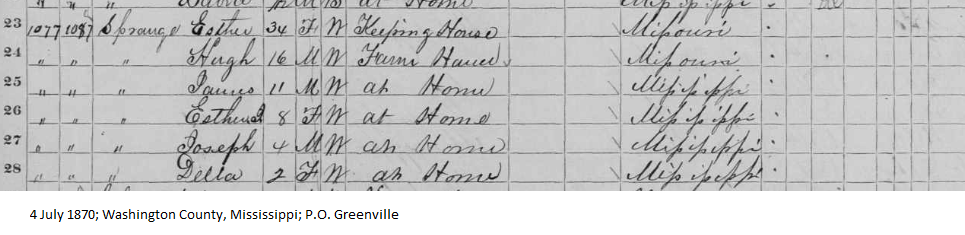
On the 1870 census, Esther Minerva Sprague, widowed, was in Washington County, Mississippi, with five children. Bartlett is missing from the household and may be deceased, but three children were added after 1860: Esther I., age 8; Joseph, age 4; and Della/Delilah, age 2.


Perhaps feeling overwhelmed with five children to raise, Esther Minerva Sprague decided to go to California, where she had a brother - "Jack" Pool. A descendant of hers told me that Esther and the children were taking the train to California in 1873 when Esther became sick and died in Parsons, Kansas. The children were stranded, so their grandmother, Leah Sprague, came and got them and took them to live with her in Bourbon County, Kansas, for a few years. Eventually, the three Sprague daughters and their brother, James Maurice Sprague, made it to California. The whereabouts of Hugh and Joseph are still in question.

It is evident from the census records that by 1870, Leah (Smith) Sprague was no longer maintaining her own household. Therefore, the orphaned Sprague children would have been dependent on the extended Sprague family. Additionally, I have not found a record of Leah being in Bourbon County, Kansas, although she may have been there at some point.

In 1865, Leah (Smith) Sprague was living in her son Columbus Sprague's household in Douglas County, Kansas.

In 1870, she is head of household, living in Douglas County, Kansas, with sons Perry and John.

In 1875, Leah Sprague was still in Douglas County, Kansas, but living in her son Perry Sprague's household along with her granddaughter Delilah Sprague, daughter of Esther M. Pool. The other children of Oliver R. and Esther Minerva (Pool) Sprague are not in the household.


Clearly, not all of the Sprague children were living with their grandmother, Leah, and their whereabouts have not been determined.

Leah Sprague supposedly died in 1881, but has not yet been found on the 1880 census. In 1880, Leah and her orphaned grandchildren were not in the household of her son Columbus, who was in Bourbon County, Kansas; or her son Perry, who was in Allen County, Kansas; or her son John C. Sprague, who was in Multnomah County, Oregon. It is possible that Leah was in the household of her son, Guilford, or on her own, which seems doubtful since she has been living with her various children since 1865.

By 1880, some of the orphans or Oliver Sprague and Ester Minerva Pool, were fending for themselves. Esther Ione Sprague was in Ottawa, Franklin County, Kansas, in the Silas Piersoll household.


Joseph Sprague was in the household of Thomas F Blair in Marion, Bourbon County, Kansas.


James Maurice Sprague and Della/Delilah Sprague turn up later in California, so they were still living in 1880.

What happened to Hugh Sprague? He does not appear on any census after 1870. This newspaper clipping indicates that Hugh Sprague died in Oswego, Labette County, Kansas, in 1873 and is likely buried there in an unmarked grave.