Showing posts sorted by date for query James Pool. Sort by relevance Show all posts

Sunday, June 16, 2019

Hugh Sprague, Son of Esther Minerva (Pool) Sprague

©  Kathy Duncan, 2019

Hugh Sprague's story begins with his mother, Minerva Esther Pool, who was a daughter of Phebe (Holcomb) and James Pool, the blacksmith.

Esther Minerva "Minnie" (Pool) Sprague


In 1850, Minnie Pool was living in the McDonald County, Missouri, household of her first cousin (and my great-great-great-grandmother) Hannah Holcomb, wife of John C Walker. Minnie was sixteen years old, and her sister Sarah was also living with the Walkers. At that time, their mother, Phebe, was deceased, and their father, James Pool, was in Santa Fe, New Mexico, along with their brother Andrew Jackson Pool.


Esther Minerva Pool married Oliver Robert Sprague in Jackson County, Missouri, on 1 April 1853.


By 1857, they were living in Mississippi. Specifically, by 1860, they were in Warren County, Mississippi, with three little boys: Hugh, age 5; Bartlett, age 3; and Morris, age 1. Oliver R. Sprague served in the Civil War and died in 1870.


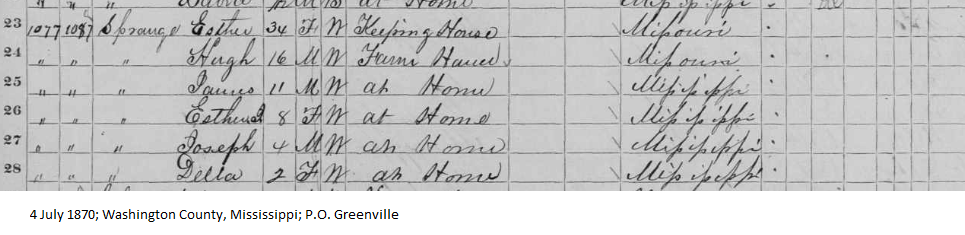
On the 1870 census, Esther Minerva Sprague, widowed, was in Washington County, Mississippi, with five children. Bartlett is missing from the household and may be deceased, but three children were added after 1860: Esther I., age 8; Joseph, age 4; and Della/Delilah, age 2.


Perhaps feeling overwhelmed with five children to raise, Esther Minerva Sprague decided to go to California, where she had a brother - "Jack" Pool. A descendant of hers told me that Esther and the children were taking the train to California in 1873 when Esther became sick and died in Parsons, Kansas. The children were stranded, so their grandmother, Leah Sprague, came and got them and took them to live with her in Bourbon County, Kansas, for a few years. Eventually, the three Sprague daughters and their brother, James Maurice Sprague, made it to California. The whereabouts of Hugh and Joseph are still in question.

It is evident from the census records that by 1870, Leah (Smith) Sprague was no longer maintaining her own household. Therefore, the orphaned Sprague children would have been dependent on the extended Sprague family. Additionally, I have not found a record of Leah being in Bourbon County, Kansas, although she may have been there at some point.

In 1865, Leah (Smith) Sprague was living in her son Columbus Sprague's household in Douglas County, Kansas.

In 1870, she is head of household, living in Douglas County, Kansas, with sons Perry and John.

In 1875, Leah Sprague was still in Douglas County, Kansas, but living in her son Perry Sprague's household along with her granddaughter Delilah Sprague, daughter of Esther M. Pool. The other children of Oliver R. and Esther Minerva (Pool) Sprague are not in the household.


Clearly, not all of the Sprague children were living with their grandmother, Leah, and their whereabouts have not been determined.

Leah Sprague supposedly died in 1881, but has not yet been found on the 1880 census. In 1880, Leah and her orphaned grandchildren were not in the household of her son Columbus, who was in Bourbon County, Kansas; or her son Perry, who was in Allen County, Kansas; or her son John C. Sprague, who was in Multnomah County, Oregon. It is possible that Leah was in the household of her son, Guilford, or on her own, which seems doubtful since she has been living with her various children since 1865.

By 1880, some of the orphans or Oliver Sprague and Ester Minerva Pool, were fending for themselves. Esther Ione Sprague was in Ottawa, Franklin County, Kansas, in the Silas Piersoll household.


Joseph Sprague was in the household of Thomas F Blair in Marion, Bourbon County, Kansas.


James Maurice Sprague and Della/Delilah Sprague turn up later in California, so they were still living in 1880.

What happened to Hugh Sprague? He does not appear on any census after 1870. This newspaper clipping indicates that Hugh Sprague died in Oswego, Labette County, Kansas, in 1873 and is likely buried there in an unmarked grave.


Saturday, October 21, 2017

The Two Azariah Holcombs

© Kathy Duncan, 2017

The two Azariah Holcombs were very likely first cousins, born only a couple of years apart. The only similarity between them is their name. However, many descendants in my line insist on confusing them, merging them, and muddling them up in a variety of ways.

Normally, confusion of this sort results when two men of the same name live in the same place in the same time period. Sorting them out requires the usual tools of genealogy research: documents, math-- sometimes a calculator comes in handy, maps--or just a basic sense of U.S. geography, and logic—an ability to connect the dots. Presently, DNA test results are used, but more of that later. The one tool that you won’t find on my list or in my toolbox is a sledge hammer. I know a lot of researchers resort to a sledge hammer when the dots don’t connect; they just pound that square peg into a round hole until wedges into place. Why? Probably because it seems to eliminate uncertainty. Maybe because it nets them a “desirable” lineage. Ultimately, the sledge hammer method is, at its worst, unethical and, at its best, sloppy and lazy.

Now, to the two Azariah Holcombs. I am going to refer to them here as “the other Azariah Holcomb” or “the New York Azariah Holcomb” because he was born in New York as opposed to “my Azariah Holcomb” or “the Missouri Azariah Holcomb” because he was born in Missouri.

First up, the other Azariah Holcomb, who was born in Sand Lake, New York and died in Sugar Grove, Pennsylvania. His tombstone, which can be viewed on his Findagrave memorial states that his birth date was May 8, 1802, and his death date was May 9, 1889. He shares his tombstone with his wife Mary Ann, who was born Feb. 1, 1812 and died Sept. 12, 1903. They are buried in the Wesleyan Cemetery in Sugar Grove, Warren County, Pennsylvania.

This Azariah Holcomb’s birth date exactly matches the birthdate of the son of Azariah Holcomb Sr. and his wife Christina Shephard as provided in Azariah Holcomb Sr’s Revolutionary War pension file.


Notice the long list of siblings for Azariah Holcomb Jr. that are provided here. They include Melita Holcomb, Junia or Junius Holcomb, Michal Holcomb (a daughter), Lunia Holcomb, Azariah Holcomb, Marianne Holcomb, Aretus Lyman Holcomb, Christina Holcomb, Gilson Holcomb, John S. Holcomb, and Lamira Holcomb. 

Note there is also a Mary Ann P. Cole or Cale born whose birth date is only a few days different from the birthdate of Azariah Jr.’s wife Mary Ann, who shares a tombstone with him. Evidently, Azariah and Christina Holcomb’s bible also contains the birth records of some of their children’s spouses.
Azariah Holcomb Sr.’s Revolutionary War Pension file is also important because it contains his statement of where he resided after the war:


Note that Azariah Holcomb Sr. states he was born in Simsbury, Connecticut, and after the war he moved to Vermont, where he lived for three years. Unfortunately, he does not state how soon after the war he moved to Vermont. Then he moved to Sand Lake, New York where he lived continuously for the next forty years or so. Since his deposition was given in 1832, we can count backward from 1832.  That would mean he was in Sand Lake, New York from roughly 1792 to 1832, possibly earlier. That means that he was not living in Missouri during those years. Therefore, the children listed in his bible were born in New York. Also, since he married Christina Shephard in 1789 and she survived him, Christina is the mother of all of his children.

My conclusion:  Azariah and Christina (Shephard) Holcomb of Sand Lake, New York had a son named Azariah Holcomb Jr., born on May 8, 1802. Azariah Holcomb Jr. married Mary Ann P. Cole or Cale and moved to Sugar Grove, Warren County, Pennsylvania.  Based on census records, Azariah and Mary Ann lived in Warren County from at least 1850 until his death in 1889.

Warren Co., PA, 31 July 1850:

Azariah Holcomb  50 NY
Marian ----- 38 NY
Sylvester ------ 18 PA
Philander ------ 16 PA
Sherman ------ 14 PA
Almira ------ 10 F PA

Russelburgh, Warren Co., PA, 20 July 1860:

Ezeriah Holcomb  64 NY
Mary ----- 54 NY
Sherman ----- 25 PA
Norman ------ 3 PA

Warren Co., PA 25 July 1870:

Holcomb, Azariah  68 NY
-----, Mary 58 NY
-----, Norman 14 PA

Warren Co., PA 16&17 June 1880:

Holcomb, Azariah 78 NY fb. CT mb. NY
-----Mary A. 68 NY fb. NY mb. NY

Note that the other Azariah gives his father’s birth place as Connecticut and his mother’s as New York.

Next up, my Missouri Azariah Holcomb, who was a very different person from the other Azariah Holcomb of Warren County, Pennsylvania. While he is a very different person, it takes much more effort to connect his dots.

My Azariah Holcomb, according to his bible record, was born in 1800:


According to the 1850 and 1860 census records, he was born in Missouri.

14 Nov 1850 McDonald Co., MO, 53rd Dist, p. 116:

341-351:
Azariah Holcomb 50 MO
Susan   54 KY
Minerva  18 MO
Azariah Oliver 15 MO
Hulda   11 MO

1 June 1860 McDonald Co., MO, Rutledge Twp:

3-3
Azariah Holcomb 59 M Farmer $200-$20 b. MO
Susan Holcomb 63 F b. MO
A.O. Holcomb 25 M Miner b. Seneca Nation
Elizabeth Nelson 4 F b. MO
[Elizabeth Nelson was the daughter of Azariah and Susan Holcomb's daughter Minerva (Holcomb) Crook Nelson]

Azariah's birthplace is also consistently reported as being Missouri by his children who survived to 1880. However, there was no Missouri in 1800. Instead, there was a Louisiana Territory. My guess is that he was identifying his birth place as being in the area that later became Missouri.

In 1833, Azariah Holcomb is living and working at the Seneca Sub-Agency in what is now Delaware County, Oklahoma. He was hired because he was James Pool's brother-in-law. James Pool married Azariah’s sister Phoebe Holcomb in the home of Benajah Brown of Ste. Genevieve County, Missouri in 1824.

Phoebe Holcomb had a half-brother named James Brown. It is likely that Benajah Brown was Phoebe’s step-father and James Brown’s father. That would mean that her mother had married Brown after the death of her Holcomb father. Therefore, her father was deceased by 1824.

Phoebe Pool and Azariah Holcomb are named as the siblings of Enoch Holcomb in his probate. 

Specifically, the siblings of Enoch Holcomb are listed as being:

-Isaac Holcomb brother of decd who resides in St. Louis County
-Nathaniel Holcomb brother of decd who resides in California
-Azariah Holcomb
-The children of Esther Jameson who was a sister of dec who reside in the Southwestern part of the state of Missouri
-The children of Phoebe Pool whose residence is unknown

The birth order of these Holcomb siblings is roughly this:

Esther Holcomb b.c. 1796 in Tennessee
Enoch Holcomb b.c. 1799 in Missouri
Azariah Holcomb b.c. 1800 in Missouri
Isaac Holcomb b.c. 1803 in Missouri
Nathaniel Holcomb b.c. 1805 in Missouri
Phoebe Holcomb's exact birth year cannot be determined because she died prior to the 1850 census. On the 1840 census she is 30 - 39 years old, which places her birth between 1801 and 1809. Since Phoebe married James Pool in 1824, her birth date would be closer to 1801, making her anywhere from 23 to 14 at the time of her marriage. Since there is no consent given for her, she was likely of age.
Hannah Holcomb b.c. 1812 in Missouri
James Brown  b.c. 1818 in Missouri

Since Enoch’s probate does not name a brother James Brown, that suggests that Enoch Holcomb and James Brown do not share the same mother. Given the range of these children’s births, 1796 to 1818, it is possible that their father had two wives. However, the fact that the Browns only seem to have had one child suggests a woman at the end of her child bearing years, so all of these children may have had the same mother, and James Brown’s omission from Enoch Holcomb’s estate settlement may be an oversight.  

More importantly, note that none of these children was born in New York. Their father is deceased by 1817, and their mother has remarried a Brown. Their mother cannot be Christina (Shephard) Holcomb, whose husband Azariah is still living in New York in 1818 when James Brown was born in Missouri.

So who is my Azariah Holcomb’s father? My favorite candidate is a Nathaniel Holcomb who was living in Ste. Genevieve, Louisiana Territory [now Missouri] in 1805 and 1806 when he was sued by William Cochran's estate for a debt of about $50.

Signature from William Cochran dec'd lawsuit


In 1806, he signed a petition in Ste Genevieve in the Louisiana Territory.

He was deceased by 1818 when Titus Strickland, acting as guardian to his heirs, was trying to clear up the title for land in Missouri. Strickland's efforts continued through 1820. To date, the names of the heirs of Nathaniel Holcomb are unknown.


My final conclusion is that only one of the two Azariah Holcomb’s can be the son of Azariah and Christina (Shephard) Holcomb, and that their son was the other Azariah Holcomb—the one who married Mary Ann and died in Sugar Grove, Pennsylvania.

If my Azariah Holcomb's father is Nathaniel Holcomb, then who was Nathaniel connected to and how could the two Azariah’s be cousins?? Nathaniel Holcomb was likely the missing Nathaniel Holcomb VI, son of Nathaniel Holcomb V and Hannah Holcomb, and a brother to the Azariah Holcomb who married Christina Shephard. Obviously, a lot more research needs to be done to establish who Azariah Holcomb's father was and what his connection was to the Holcombs of Connecticut. 


Sunday, April 3, 2016

James Skaggs, Jasper County, Missouri Probate

© Kathy Duncan, 2016

James Skaggs, husband of Hannah (Holcomb) Skaggs, was deceased with an estate in Jasper County, Missouri, by 1859. Notably, Hannah Skaggs was made guardian of their minor children: Sarah Skaggs, Hester A. Skaggs, and Flora Skaggs in early 1860. This is a significant document since the Skaggs family was evidently in route to California by wagon train in the summer of 1860 when the US census was taken. Hester A. Skaggs and Flora Skaggs were born after 1850, were missed by the 1860 census, and evidently married or deceased by the 1870 census when Hannah was living with her daughter Nancy (Skaggs) Witter

Flora Skaggs had married William Simmons, but was deceased by 1880 when her grandmother Hannah Skaggs and great-uncle James Brown were living in the same household with William Simmons and their daughter.

The hunt for Hester Skaggs begins...oh, oh, found her: Hester A. Skaggs married John L. Gibson 3 July 1866 in Calaveras County, California, where her sister Flora married William Simmons.

Meanwhile, the icing on the cake is additional information that Hannah's nephew Andrew Jackson Pool acted as security.

Jasper County Court Monday December 19th AD 1859
Ordered by the Court that Rice Charles administrator of the Estate of James Skaggs, deceased, pay to the widow of the said deceased fifty dollars, for provisions, clothing and tuition of the children of the deceased
Bk. D, p. 43
[Jasper County, Missouri, Probate Court Minutes, 1855-1861, vol C-D]


click image to enlarge


Jasper County Court Tuesday February 28th 1860 (2nd day)
Ordered by the Court that Hannah Scaggs be and she is hereby appointed Guardian of the persons and Curator of the estates of Sarah Skaggs, Hester A. Skaggs and Flora Skaggs. Minor heirs of James Skaggs deceased, said Hannah Skaggs presented cause as such Guardian & Curator in the sum of two hundred dollars with Thomas J. McDougald and Andrew J Pool as securities which bond was approved by the Court
Bk. D, p. 76
[Jasper County, Missouri, Probate Court Minutes, 1855-1861, vol C-D]

Jasper County Court March 2nd AD 1860
Now at this day came Rice Charles administrator of the estate of James Skaggs, deceased, and made application to the Court to make his amende final settlement, according to an order of this court. It is therefore consider by the Court that said administrator make said amended settlement, and it appearing to the Court from the accounts here produced and fled that said administrator is chargeable with the sum of six hundred and fifty one dollars and forty-nine cents ($651.49) and that he is entitled to credits amounting to the sum of six hundred and eighty four dollars and eight cents ($684.08) leaving the sum of thirty two dollars and fifty nine cents due said administrator, all of which was approved by the Court.
Bk D, p. 96
[Jasper County, Missouri, Probate Court Minutes, 1855-1861, vol C-D]


Friday, December 26, 2014

JAMES POOL, Blacksmith for the Seneca and Delaware Tribes

© Kathy Duncan, 2014

Fortunately for me, James Pool, the blacksmith, for the Seneca, Delaware, and Shawnee, left a paper trail a mile wide, and it keeps growing. It was through him that I was finally able to document any family connections for Azariah Holcomb - they were brother-in-laws. Knowing that Azariah Holcomb and Phoebe Pool were siblings, made it possible to link them both to their brother Enoch Holcomb.

James Pool was born in Virginia c. 1809 in Virginia. and died sometime after 1867, location unknown.

James Pool married Phebe Holcum on 8 Aug 1824 in St. Genevieve County, Missouri in the home of Benaja C. or Benajah Brown. Brown probably had some sort of family connection to Phebe since her brother was James Brown.

Phoebe Holcomb was the sister of Azariah Holcomb.

The known children of Phoebe (Holcomb) and James Pool:

1. George W. Pool
2. Andrew Jackson Pool
3. Esther Minerva Pool
4. Sarah A. Pool

James Pool lived in the Delaware village from about 1822 to 1830:
"Another Kaskaskian, James Pool, and his white wife, Phoebe, lived in the Delaware village from about 1822 to 1830. Pool, who was the Delaware blacksmith, was an employee of the government at the James Fork Trading Post."
[Source: White River Valley Historical Quarterly; vol. 6, no. 3, Spring 1977
http://thelibrary.org/lochist/periodicals/wrv/V6/N3/Sp77d.htm]

The source above may be the cause for some to speculate that James Pool was a half-breed. Note that no primary sources to date reference him as being an Indian of any tribe. The Kaskaskia were an Illinois tribe, not a Virginia tribe. James Pool's birth in Virginia would seem to negate the possibility that he was a Kaskaskian Indian. Three primary documents generated during his lifetime state that he was born in Virginia.: the 1850 census and two treasury department registers, examined below. The reference that James Pool was a Kaskaskian is probably more accurately a reference to his possible residence on Kaskaskia Island near Ste. Genevieve County, Missouri. It would have a been a likely residence since he was well acquainted with its inhabitants; however, he is just as likely to have been a resident of Ste. Genevieve County, Missouri. The statement above, indicating that Phebe was "his white wife," probably stems from Joseph Philibert's deposition given in 1875 in the Missouri Supreme Court case against the William Gillis Estate:

"Int. 89 Were you acquainted with James Pool at James Fork trading post. If yea, state how long said Pool lived there, what was his employment and his wife's name if you recollect it.

Ans. I was acquainted with Pool before we came to this country. He was here when I came. He was the Delaware blacksmith - employed by the government at James Fork trading post. He lived there until 1820 [sic - should be 1830] when he moved to the Kaw river I was acquainted with with Mrs. Pool. I think her name was Phebe. Mrs. Pool left with Mr. Pool for Kaw River in the fall of 1830. She, Mrs. Pool, was a white woman."
[Source: Transcript of Joseph Philibert Deposition in Missouri Supreme Court Case Against the William Gillis Estate. Filed January 15, 1875. Contributed by Wilma Fields]
http://freepages.genealogy.rootsweb.ancestry.com/~biddle/deposition1.html

 This deposition probably stresses that James Pool's wife was white because many of the fur trappers and government workers had taken Indian wives. The deposition seems to be a partial attempt to account for the women in the area. Without seeing the rest of Gillis's case file, it is impossible to speculate as to why this specific question was asked.

Iron objects and smelting wastes have been excavated by researchers from the Center for Archaelogical Research, Missouri State Universty, from the site where James Pool's blacksmith shop probably stood in DelawareTown on the James Fork of the White River. That site was catalogued as 23CN455 by researchers.
[Source: Delaware Town; Where the Wilson Meets the James]
http://delawaretown.missouristate.edu/delaware.html

The site of his smithy can been seen on a map contributed by Marcie Venner. See map labled as sites in James River Valley, including those with reported actual Delaware occupation.
[Source: The Delaware Along the James, uploaded by Marcie Venner]
http://www.academia.edu/3365045/The_Delaware_Along_the_James

Further research published in 2011 indicates that 23CN455 might have been a farmstead that site 23CN1B might actually be the blacksmith operation run by James Pool.
[Source: Archaeological Investigations of Delaware Occupation In the James River Valley of Southwest Missouri; Research Report No. 1452; Center for Archaeological Research; Missouri State University, 2011, by Marcie L. Venter et al]

In April of 1826, Pierre Menard wrote a letter from Kaskaskia to Indian Agent Richard Graham of the St. Louis Superintendency of Indian Affairs at St. Louis that James Pool reported "from the James Fork of the White River [Arkansas-Missouri] concerning the murder of several Delawares. Sixty or seventy Delawares were reported to be at either Anderson's or Nanundagum's Town and only three old men at Roastinger's Town about 300 yards from Marshall's on Finly...at a distance of about nine miles he can see the house of La-pa-ni-hile [eldest brother of Captain Ketchum] in flames.
[Source: Richard Graham papers, Clark Collection, vol. 10, Missouri Historical Society, CKH, p. 147]

On 10 June 1826, James Pool was one of the witnesses to a voucher for $5,300 from Richard Graham to the chiefs, councilmen, and captains of the Delaware.
[Source: The Delaware Indians: A History by C. A. Weslager]

On 24 September 1829, the government negotiated a new treaty with the Delawares that canceled their right to the lands on the James Fork in Missouri, where they were in residence and allotted land to them along the Kaw River [Kansas River] in present day Kansas. In the fall of 1830 many tribal members began the move under their own volition, arriving there in November of 1830.
[Source: The Delaware Indians: A History by C. A. Weslager]

On December 1831, Pierre Menard, paid James Pool $93 for transporting the Delaware from the White River to the Kansas River.
[Source: Kansas Historical Review, vol. 8, ed. Francis Asbury Sampson]

Leading members of the Church of Latter Day Saints arrived in Independence, Missouri in 1831 with the intent of converting the tribes to Mormonism. They crossed the Kaw [Kansas River] into the Delaware tribal lands. Parley P. Pratt wrote the following:
"There was an interpreter present and through him we commenced to make known our errand, and to tell him of the Book of Mormon. We asked him to call the council his nation together and give us a hearing in full. He promised to consider on it till next day, in the meantime recommending us to a certain Mr. Pool for entertainment; this was their blacksmith, employed by government...We again lodged at Mr. Pool's told him of the Book, had a very pleasant interview with him, and he became a believer and advocate for the Book, and served as interpreter."
[Source: Autobiography of Parley Parker Pratt, 1807 - 1857]

On 31 December 1833, Perre Menard, paid James Pool $93 for transporting the Delaware from White River to the Kansas River.
[Source: Congressional Serial Set, Government Printing Office, 1835]

8 June 1831, $8 paid to James Pool for two grindstones by R.W. Cummins found in Abstract Y: Abstract of Expenditures and Disbursements by William Clark, Superintendent to Indian Affairs at St. Louis, to carry into effect the supplementary article concluded at Council Camp on James Fork of White River, Missouri, the 24th Sepetember, 1829, to the Treaty with the Delawares of 3d October, 1818
[Source: Indian Removal Records - Senate Document #512, 23 Cong., 1 Sess. Vol. V]

In 1833 James Pool was hired as a carpenter for the Senecas of Sandusky at the Seneca Sub-Agency located in present day Delaware County, Oklahoma.

The following was written by Frank H. Harris:

"Acting on the recommendation of the Governor of Missouri, Commissioner Ellsworth on August 1, 1833 hired James Pool, from Independence, Missouri, to perform the duties of blacksmith for the Senecas of Sandusky. He also hired Azariah Holcomb, Mr. Pool's brother-in-law, as carpenter, to assist in the proposed erection of a grist mill for the Senecas. These two men did good service for the Senecas for several years. Cherokee West Agent, Vashon, complained in 1835, that Commissioner Ellsworth had no authority to hire the two men.

"Lieutenant Van Horne, while acting Seneca Sub-Agent in 1833, allowed Mr. Pool and his family to live at the Agnecy house. Van Horne state, 'As there seemed to me little probability that the Agency House would be required for the residence of a Sub-Agent: and as it was likely to go to ruin if not occupied: I have directed the blacksmith to occupy it at present.' Mr. Holcomb and his family were sick and were also allowed to live there, where they were cared for by the Pool family. Lieut. Van Horne, conscious of Mr. Holcoomb's illness, reported [on Dec. 31, 1833], 'I think it my duty to say that in my opinion, the man is unfit to be employed by the Department, either as a carpenter or miller.'

"The first blacksmith shop for the Senecas was built on the grounds near the Agnecy House, by Mr. Pool and Mr. Holcomb. It was built, 'of hewn logs, a naile on roof and cost together with the coal-house, only $15.80."

James Pool remained as blacksmith for the Seneca until 1841. Azariah Holcomb left earlier.
[Source:  Harris, Frank H. "Seneca Sub-Agency, 1832-1838." The Chronicles of Oklahoma. p. 75 - 95.]

By 1840, James Pool and family were in Newton County, Missouri.

1840 Elk River Twp, Newton County, MO, page 227:
James Pool 0111101-200001

James Pool's 1840 household consists of the following:
one male age 5 - 10 = Andrew J. Pool
one male age 10 - 15 = unidentified male
one male age 15 - 20 = George W. Pool
one male age 20 - 20 = unidentified male
one male age 40 - 50 = James Pool
two females under age 5 = Minerva E. and Sarah A. Pool
one female age 40 - 50 = Phebe (Holcomb) Pool

The unidentified males are either sons who died during the next decade or males employed by James Pool. This is the only census on which Phoebe appears since they were living on the James Fork of the White River  in 1830.

On 25 June 1841 James Pool, a resident of Missouri shot William Shearer, a resident of Newton County, Missouri. The wound was serious, and it was believed that Shearer would die. The offense was committed within the Seneca Nation, so when James Pool was apprehended by Daniel M. Strickdon, a blacksmith employed by the government, he was turned over to John B. Luce, Neosho Sub Agent. Luce sent Pool to Fort Wayne, which was the nearest military post, with the request that he be turned over the Marshall of Arkansas. On July 8, 1841, J. P. Simonton, the authority at Fort Wayne reported that two individuals reported at Fort Wayne, stating that they had been responsible for delivering James Pool, but that he had escaped in route. They turned over Luce's letter. However, on July 5th, James Pool himself had turned up at Fort Wayne and surrendered himself. Simonton complained that he lacked instructions of any kind that would guide him in determining what to do with Pool. Evidently, James Pool was taken to Fort Smith. On July 13, 1841, S. G. Simmons of the Western Division at Fort Smith reported back to Capt. S. P. Simonton at Fort Wayne that James Pool had been set free since it "would be useless to send him before a magistrate without some of the witnesses in the case." He admonished Simonton that "hereafter whenever a prisoner is sent before a magistrate, that sufficient testimony also be sent to commit him, if guilty."
[Source: Fold3]

Shortly after this James Pool and family removed to Independence, Jackson County, Missouri where James Pool operated his own blacksmith shop and assembled wagons for the Santa Fe trade.

The children of Phoebe Holcomb are identified in a lawsuit brought by Samuel Woodson against James Pool et al and settled by the Missouri State Supreme Court in 1853. This suit centers on establishing a clear title for a piece of land that had been purchased from Hall and held in trust by James Brown for Phoebe Pool and her children. One deposition relates the information that Phoebe had instigated the purchase of a piece of land in Independence, Missouri on which she wished to build a small house for herself and her children. The question was whether James Pool had placed the land in trust for Phoebe as a means of evading his creditors. Eventually, the land had been sold because of James Pool's debts. Phoebe had died. A clear title was now in question. James Pool himself had left for Santa Fe before 1850, leaving only some of his children scattered in Missouri. The result is over a 100 pages of depostions that were collected by the Missouri State Supreme Court to settle the matter.

In 1848, James Pool purchased 63 acres of land from Lydia Partridge, widow of Edward Partridge, and which he later sold to John Maxwell. James Pool must have almost immediately sold the property to Maxwell, since Pool was in Santa Fe, New Mexico by 1850. This property became the controversial Temple Lot Case. The Mormons believed that this particular parcel was Zion.

The second lawsuit, Church of Christ v. Reorganized Church of Jesus Christ of Latter-Day Saints:
"The bill of complaint further averred that after the death of said Edward Partridge, to wit, on May 5, 1848, his widow, Lydia Partridge, and three of his children, conveyed the lots in controversy to James Pool, notwithstanding the face that they had no title thereto by reason of the previous conveyance of the same on March 28, 1839, to the minor children of Oliver Cowdery; that aid James Pool, shortly thereafter, conveyed said property to John Maxwell; and that, by virtue of several other purchases and mesne conveyances, the Pool title to the premises in controversy became vested in one Granville Hedrick in trust for the Church of Jesus Christ of Latter-Day Saints, which said last-named church the bill averred to the same church under a different name, as the Reorganized Church of Jesus Christ of Latter-Day Saints. The bill furthered averred that Gravnille Hedrick subsequently died, and that in an ex parte proceeding begun in the circuit court of Jackson county, Mo., Richard Hill, one of the defendants, was appointed trustee to hold the property and execute such trusts as may have been reposed in Granville Hedrick...Besides denying some other material allegations of the bill, the defendants pleaded substantially the following facts: That James Pool purchased the property in controversy from Lydia Partridge, the widow of Edward Partridge, and from Eliza M. Partridge, Emily D. Partridge, and Caroline E. Partridge, the children of Edward Partridge, in the year 1848, paying therefor the sum of #$300; that, at the time of making said purchase, said Pool had no notice whatever that any other person or persons claimed to have any interest in the property, and that the deed conveying the same to said James Pool was duly recorded in the proper registry office of Jackson county, Mo., on June 16, 1848; that James Pool shortly afterwards sold and conveyed said property to John Maxwell, who was also an innocent purchaser of the same for value; and that by virtue of numerous other conveyances thereafter made, which were specifically described in the defendants' answer, the title to lots 16, 20, and 21, originally acquired by James Pool from the heirs of Edward Partridge, became vested in John H. Hedrick prior to November 8, 1869; and that the title of said James Pool to lots 15, 17, 18, 19, and 22 became vested in one William Eaton prior to November 5, 1877...The deed for the same property that was executed by the widow and children of Edward Partridge on May 5, 1848, was filed for record and was recorded in Jackson county, Mo., on June 16, 1848. It purported to convey to James Pool, for an expressed consideration of $300, a tract of land described by metes and bounds, containing 63.43 acres. This tract was subsequently subdivided into five additions to the city of Independence, Mo., by persons who claimed title to  the same under the conveyance to James Pool of date May 5, 1848. The first of these additions which embraces the lots in controversy, was made by Woodson & Maxwell, by a plat duly filed and recorded as early as March 31, 1851. Two other additions were carved out of the tract, and plats thereof were filed in the years 1866 and 1868. The residue of the tract became additions to the city by plats which were approved by the city authorities and filed during the years 1886 and 1887, respectively. Since the tract was thus subdivided into additions, and attached to the city of Independence, hundreds of persons have bought lots therein in reliance on the Pool title. Streets and alleys have been opened through the tract, and many buildings and other improvements have been erected, at great expense to numerous occupants of the property. These improvements began, as it seems, long prior to the year 1870, and have continued without interruption to the present date. The record further shows that the lots in controversy became the subject-matter of a suit in partition between the heirs of  John Maxwell, deceased and Samuel H. Woodson, in the year 1859; and that by virtue of the decree in that suit, said lots were subsequently exposed for sale, and some of them were actually sold and conveyed to the respective purchasers. It should be stated in this connection that John Maxwell purchased the Pool title to the 63 acre tract originally owned by Edward Partridge as early as August 3, 1848. He entered into a contract with Samuel H. Woodson in February, 1851, by virtue of which the latter acquired interest in the property; and after the death of Maxwell and after the laying out of Woodson & Maxwell's addition, Woodson bought the aforesaid suit in partition against the heirs of Maxwell, which resulted in the decree of partition last mentioned and in a judicial sale of the premises in controversy.
[Source: The Federal Reporter, vol. 70 Cases Argued and Determined In The Circuit Courts of Appeals and Circuit and District Courts of the United States; November, 1895 - January, 1896]
https://bulk.resource.org/courts.gov/c/F1/0070.f1.pdf

In 1850 James Pool was in Santa Fe, NM

Sante Fe., New Mexico Territory, p. 374:

1119/1119
James Pool 41, Blacksmith 40.000 or 10.000  born in VA
Jackson ---- 17 Blacksmith 4.000 born in MO
W? Henry Price 28 blacksmith 20 born in MD

James Pool's daughters, Minerva and Sarah Pool, were living in Missouri with his niece Hannah (Holcomb) Walker, daughter of Azariah Holcomb. No doubt all involved felt that the girls would be better off in Missouri than being exposed to the dangers of the Santa Fe trail.

1850 McDonald Co., MO p. 112:

John Walker 28 Farmer 500 b. TN
Hanah 26 b. MO
Louiz 6 b. MO
Azariah L.  4 b. MO
Julian 3 b. MO
Pleasant 8/12 b. MO
Minerva E. Pool 16 b. MO
Sarah A. Pool 14 b. MO

By June of 1851 James Pool had left Santa Fe, New Mexico. Presumably, his son Andrew Jackson Pool was with him. They probably were in route to Missouri. From there James Pool went to Washington, D.C. to press his claim for reimbursement for his services to the Seneca Indians back in the 1820s and 30s. More than likely he left Andrew J. Pool in Missouri. His daughters probably continued to live with relatives in Missouri.


By 1852 James Pool was in residence in or around the Washington, DC area and had taken a second wife: Eliza Jane Harding of Maryland. It seems reasonable that he may have sent for his daughter, Sarah, to join him and his new wife in Washington, DC. Since no marriage records have been discovered yet in Missouri for her, hopefully one will come to light in the DC area. Daughter Minerva married in Missouri.


In 1852/53 James Pool's brother-in-law Enoch Holcomb died. Enoch Holcomb's estate, case #03827B, was filed in St. Louis County, Missouri in 1852/3. His probate named his siblings: "Isaac Holcomb brother of decd who resides in St. Louis County and Nathaniel Holcomb brother of decd who resides in California and Azariah Holcomb and Hannah wife of James Scagg and the children of Esther Jameson who was a sister of decd who reside in the South western part of the state of Missouri and the children of Phoebe Pool whose residence is unknown to me."

James Pool's claims for his unpaid services for the Shawnee, Seneca, and Delaware tribes began appearing in the Washington, DC newspapers by 1852.

"Mr. Atchison, from the Committee on Indian Affairs, to whom was referred the petition on James Pool, praying compensation for his services as blacksmith and striker for the Shawnees and Delaware tribe of Indians, reported a joint resolution to authorize the settlement of the accounts of James Pool; which was read and passed to a second reading."
[Source: Daily Union; Washington, DC; Sunday 22 August 1852]

"Mr. Atchison. I wish to submit a motion to postpone the prior orders, and that the Senate proceed to the consideration of Senate joint resolution No. 57; and I make an appeal to the Senate to do this as a matter of charity. This joint resolution is for the settlement of the accounts of a poor blacksmith, who has been here during the last eight or nine months of the present session. He has a small claim against the government, and he is in great need of the money, and has made an appeal to me to have the matter ated upon. I hope this joint resolution will not be taken up.

The motion being agreed to, the joint resolution to authorize the settlement of the accounts of James Pool was read the second time, and considered as in committee of the whole. It provides that the proper accounting officers the treasury be directed to adjust and settle, upon principles of equity and justice, the claims of James Pool, arising out of the services of himself and striker in the blacksmith shops of the Delaware, Seneca and Shawnee tribes of Indians; and that the balance, if any, that may be found due, be paid to the said Pool, or his legal representatives, out of any money in the treasury not otherwise appropriated; provided that the amount shall not exceed, $3,531.67.

No amendment being made, the joint resolution was reported to the Senate, and ordered to be engrossed for a third reading."
[Source: Daily Union; Washington, D C; Fri. 27 August 1852]

"Mr. D. [Dodge of Iowa] also presented a supplemental petition of James Pool, praying remuneration for services rendered, under contract, to the Seneca nation of Indians; which was referred to the Committee on Indian Affairs."
[Source: Daily Union; Washington, DC; Tues. 14 February 1854]

"Mr. Wade: I am directed by the Committee on Claims, to whom was referred the petition of James Pool, to submit a report, accompanied by a bill for his relief. I ask the Senate to consider the bill now. It is for the benefit of a poor man, who has been waiting here for a long time, and it is proper that it should be disposed of at once.

The bill was read a first time, and ordered to a second reading. It proposes to direct the proper accounting officer of the Treasury to pay to James Pool $2,262 for money advanced by him to purchase corn for the Seneca and Shawnee Indians in the spring of 1834, at the request of Governor Stokes, Indian agent, and interest thereon; and for interst on sundry sums advanced by him for the use of those Indians, between the years 1823 and 1838, which sums were not refunded until 1853, for want of appropriations for that purpose; and this amount is to be in full for all existing claims of Pool against the United States, growing outo f any transactions with those tribes.
The President: The Senator from Ohio asks for immediate consideration of the bill. It requires unanimous consent. Is there objection?
Mr. Stuart: I do not propose to object to the consideration of the bill; but inasmuch as the report is not printed, I should be glad if the Senator from Ohio would, state briefly what are the circumstances of the case.

There being no objection, the Senate proceeded to consider the bill as in Committee of the Whole.

Mr. Wade: The bill received the unanimous sanction of the Committee on Claims. Contrary to our usual customs, we propose in this bill to allow interest on certain advances made by this individual while he was engaged as a blacksmith among the Indians. It comes within the rule which has been adopted by the committee, and , I believe, sanctioned by the Senate. The sums which he paid out have since been refunded by the Government; the inability of the Government to pay them has thereby been acknowledged. His account was presented many years ago, and payment was refused [barely?] because there was no appropriation to meet it. Under such circumstances, we have always allowed interest, I believe, and in no other case, so far as I know. In this case, coming within the rule, we propose to award interest from the time when the presentation of the claim was made and payment refused. That is the principle on which the bill is founded. The report is a long one, and sets forth all the facts.

The bill was reported to the Senate without amendment, ordered to be engrossed for a third reading, read a third time, and passed.

Mr. Wade: I now move that the report of the committee in this case be printed.
The motion was agreed to."
[Source: Daily Globe, Washington, DC; Thurs. 18 January 1855]

In 1855, James Pool took a part time job as a watchman for the Treasury Department in the District of Columbia:


The 1855 Register of Agents...In the Service of the United States supports the 1850's census report that James Pool was born in Virginia:


In 1856, James Pool appeared in the Congression Serial Set, vol. 851 as being on the payroll for his services as a watchman for the Treasury Department. The entry is titled "Statement showing the names of watchmen employed in the Treasury. The entry reads name - James Pool, time employed - from July 1 to December 31, 1855, annual salary - $600, amount paid - $300, residence - District of Columbia. The most note worthy clue here is that his residence was the District of Columbia.
[Source: Congressional Serial Set, vol. 851]

James Pool remained employed as a watchman at Treasury Department until the summer of 1861:


In 1862, James Pool was still a resident of Washington, DC and still pressing Congress for the funds they owned him. Now, however, they also owed him for his employment as a watchman for the Treasury Department, a job that he took to support himself and his family while living in Washington DC and waiting for Congress's decision in his original claim. Congress, however, was not disposed to act any faster than they had in the previous ten years! The full transcript of the 1862 congressional comments published in The Globe.

Finally, in 1867, Congress issued a proclamation for James Pool to be paid for his services to the tribes. He had been pressing Congress for fifteen years for money he had been owed since the 1830s. Note that this proclamation does not include the money owed him for being a watchman at the Treasurey Department!

"An Act for the relief of James Pool. January 22, 1867: Be it enacted by the Senate and House of Representatives of the United States of America in Congress assembled, That the Secretary of the Interior be, and he is hereby, authorized and directed to pay to James Pool the sum of twelve hundred and eighty-seven dollars and ten cents, out of any money in the treasury not otherwise appropriated: Provided, That four hundred and eighty-seven dollars and fifty cents of said amount shall be paid out of any annuities or moneys payable to the Senecas and Shawnee Indians, if there by any, and if none, then the whole sum to be paid out of the treasury of the United States."
[Source: United State Statues At Large: Treaties and Proclamations of the United States, vol 14, 1868]


Monday, March 10, 2014

Andrew Jackson Pool

© Kathy Duncan, 2014

Andrew Jackson Pool, was the son of James and Phebe (Holcomb) Pool. He was born in Missouri c. 1833. He married his first cousin Margaret Jamison. See her page for more information.

Known children of Andrew Jackson and Margaret (Jamison) Pool:

1. Robert Hugh Pool
2. Andrew Edmond Pool
3. "Clara" Gertrude Mae Pool
4. Alfred Milton Pool
5. Maud Augusta Pool
6. Wilmas Alva "Leota" Pool

Married. At Jenny Lind, January 20th, A. J. Pool to Margaret Jamison.
[Source: Daily Alta California, 30 Jan 1861 and Sacramento Daily Union 29 Jan 1861]

At Brushville, Calaveras county, Feb. 17th, the wife of A. J. Pool, of a son. [Robert H. Pool]
[Source: Sacramento Daily Union, Volume 22, Number 3410, 4 March 1862]

28 July 1870, San Juan Twp., Monterey Co., CA, p. 396:

183 - 180
Poole, A.J. 37 M W Blacksmith b. MO
---Margaret 37 F  W Keeps house b. MO
---Robert H. 8 M W b. CA
---Andrew 5 M W b. CA
---Clara G. 3 F  W b. CA
---Alfred 8/12 M W b. CA

On 1 Oct 1874, A.J. Pool and his brother-in-law W. J. McNeil rented tracts of land in Fresno County, California for one year from Miller and Lux that resulted in a lawsuit that was filed in 1878.

5 June 1880, Hollister Twp., San Benito County, California, p. 368:
49-49
Pool, Andrew W M 47 Farmer b. MO fb. MO mb. MO
----, Margaret W F 47 Wife Keeping house b. MO fb. KY mb. MO
----, Hugh W M 18 Son Student b. CA fb. MO mb. MO
----, Andrew W M 16 Son Student b. CA fb. MO mb. MO
----, Gertie W F 13 Dau Student b. CA fb. MO mb. MO
----, Milton W M 10 Son b. CA fb. MO mb. MO
----, Maud W F 3 Dau b. CA fb. MO mb. MO
----, Leota W F 2/12 Mar Dau b. CA fb. MO mb. MO
[Living nearby is the household of first cousin Nancy (Skaggs) Witter and the household of William W. England.]

Married -- ENGLAND-THOMAS -- at the residence of A.J. POOLE, Hollister, by Judge MONTGOMERY; W.W. ENGLAND of San Benito County to Mrs. Elizabeth THOMAS, of Gilroy.
[Source:  The Pacific Coast; Hollister, CA; 18 Nov. 1881]

In 1883, A.J. Pool and his brother-in-law W.W. England had this brush with a criminal:

Murder and Arson -- Last Tuesday morning at about 4 o’clock, nightwatchman AUSTIN noticed a man on horseback pass through town. In about 3 hours thereafter, an officer from Gilroy appeared in town, and then it was learned that murder and arson had been committed near San Jose on Sunday night. That intelligence being gained, Sheriff BURNETT and a posse started out with the intention of tracking the man who passed town, who, from the description given, is beyond all doubt the assassin. All day Tuesday the officers looked for the criminal, but without success. He was heard of at several different places, but no definite information could be gained.

The particulars of the foul deed are: Living at a place near San Jose, known as Lexington, was an old man named Wm. P. RENOWDEN. He was reported to be wealthy, and that he kept considerable coin in his dwelling. This was the general belief among the inhabitants in that neighborhood. On Sunday night last a Mr. Archie McINTYRE, an old friend of RENOWDEN, went to pass the night with him. At 1 o’clock of the night, Mr. W.B. RANKIN, a neighbor, heard several shots in the direction of RENOWDEN’s house, and soon thereafter he discovered the old man’s house to be on fire. He gave the alarm, but before assistance could arrive the house was destroyed. Arriving at the scene of the tragedy, the body of RENOWDEN was discovered within a few rods of the dwelling with a portion of his clothing burned off and 3 bullet wounds, one in the right cheek and 2 in the breast. Further investigation showed the charred remains of another person, which proved to be McINTYRE. The cause for the crime was money, $200 in gold being found in the ruins.

Later particulars of the double murder convey the intelligence that Jno. SHOWERS and Joe JEWELL are the murderers. SHOWERS was arrested in Gilroy on Monday, but JEWELL succeeded in making his escape. The coroner’s inquest developed the facts as stated above. We think that the Sheriff of Santa Clara county made a mistake in not telegraphing to Sheriff BURNETT immediately, who would then have been on the alert. Up to going to press, Thursday, 5pm, no news of JEWELL have been received. Why, we are unable to say, as it is an open fact that JEWELL has been and now is in the immediate neighborhood of Hollister. He took dinner at Mr. NASH’s last Tuesday, and in an hour thereafter Sheriff BURNETT was at the same place, but he could not find JEWELL. On Tuesday night the murderer slept at Mr. A.J. POOLE’s, but wasn’t there when wanted. Wednesday at 2pm he visited the ranch of Judge MURPHY, and remained there nearly an hour. But when looked for he was gone. On Wednesday night Sheriff BURNETT and W.W. ENGLAND started on a hunt for JEWELL. It is rather singular that JEWELL could possibly circulate in this neighborhood without being captured, and that too, when being pursued by some of Santa Clara County’s criminal hunters, assisted by the officers of San Benito County. As matters now appear, it looks to a man up a tree as if the officers were either afraid to meet JEWELL or else are too lazy to find him. We do not assert this as a fact, as we are ignorant of the actions of the officers, who may have plans for his capture, which, in the end, will be successful. We hope so. 
[Source: Hollister Democrat; Hollister, CA;16 March 1883]

Evidently, A.J. Pool removed to Tulare County, California by 1886.

Poole, Andres [sic] Jackson 53 Missouri  Farmer Traver   28 May  1886
[Tulare County CA Great Register of 1888]

Died -- POOL -- at Traver, Cal., Nov 9, A.J. POOL, aged 60 years.
[Source:  The Hollister Free Lance, 15 Nov 1889]

Andrew Jackson Pool's burial place has not been found yet. He was probably buried in Tulare County, California since that seems to have been his place of residence at the time.

Andrew Jackson and Margaret (Jamison) Pool's bible can be viewed  here.


Tuesday, December 31, 2013

AZARIAH HOLCOMB

© Kathy Duncan, 2013

Contrary to popular and persistent belief, Azariah Holcomb was not the son of Azariah and Christina (Shephard) Holcomb. Evidence suggests that he was the eldest son in a group of siblings whose parents have not been identified, but who lived in the area now known as Missouri by Azariah's birth in 1800. Azariah Holcomb's bible does not contain his birth date.

According to Azariah's own bible record, he married Susan on April 20, 1819. Please note that the Bible record does not contain Susan's maiden name, which tradition holds was Stafford. This will be discussed later in this post. Various online family trees and web pages place their marriage in either El Paso County, Colorado or Newton County, Missouri. Neither of these is very likely. Probably, Azariah and Susan married in southeastern Missouri near Ste. Genevieve or St. Louis. Perhaps they married in another state. The possibilities include Illinois, Kentucky, and Tennessee. However, to date, no civil or church record of their marriage has been discovered.

The 1820 census for the Missouri Territory suffered a district wide loss, so Azariah's whereabouts in 1820 are unknown. However, by 1826 he was residing in Jefferson County, Missouri.

Azariah and Susan's first child, Nathaniel Holcomb, was born on January 13, 1820. He died on October 22, 1821.

Their second child, Margaret Holcomb, was born July 20, 1822, and she died on November 10, 1822.

Their third child, Hannah Holcomb, was born on March 24, 1824. Hannah survived to adulthood.

On April 15, 1825, the Jefferson County, Missouri county court appointed Azariah Holcomb the constable of Plattin Township. The appointment was withheld pending approval of a $500 bond. On May 2, when the court met again, it was adjourned for a lack of a quorum. They met again on May 5, when Azariah's appointment was confirmed.
[Source: The Heritage News, Jefferson County Historical Society, issue 22, April 2000. Thank you, Karen Allman, for reminding me about this information.

On 19 July 1826, while residing in Jefferson County, Missouri, Azariah signed a petition to move the county seat from Herculaneum to Hillsboro along with brothers Nathaniel and Enoch Holcomb.


Azariah and Susan's fourth child, Agustus Holcomb, was born on April 5, 1826. He survived infancy, but died at the age of 18 on January 31, 1845.

Their fifth child, Phebe Holcomb, was born on December 19, 1828. She died after eight days on December 27, 1828.

Their sixth child, Mahalath Holcomb, was born on March 25, 1830, probably in Jackson County, Missouri. She survived to adulthood.

On November 26, 1830, Azariah Holcomb purchased Lots 41, 42, & 88 facing on Lexington St. in Independence, Jackson County, Missouri [Bk. A p. 39].

On December 17, 1830, Azariah Holcomb purchased Lots 95 on Kansas St. and Lots 98, 99, and 102 facing on Liberty St. in Independence, Jackson County Missouri [Bk. B p. 84].

On July 3, 1832, Azariah and Susan Holcomb sold Lots 41, 42, & 88 to James Poole in Jackson County, Missouri. [Bk. B p. 84].

Their seventh child, Manerva Holcomb, was born, probably in Independence, Jackson County, Missouri, on November 11, 1832. She lived to adulthood.

On December 29, 1832, Azariah and Susan Holcomb sold lots 95, 98, 99, and 102 to W.W. Phelps & Co. [Phelps, Cowdry, and Whitmer] in Jackson County, Missouri [Bk. B p. 135].

According to Pearl Wilcox, this location later became famous as the Robert Weston Blacksmith shop.
[Source: Wilcox, Pearl. The Latter Day Saints on the Missouri Frontier, 1972. p. 45]

The property conveyed to W. W. Phelps & Co became the subject of a lawsuit in 1856.

On January 15, 1833, Azariah purchased 12 acres from Jones H. and Clara Flourney. Part SE 1/4 & W 1/2 SE 1/4 S3 T49 R32 - 6 acres [Bk. B p. 150] and Part S end SW SE cor SE S3 T49 R32 -a triangular spaced piece of land containing 6 acres [Bk.  p. 563]

On August 15, 1833, Azariah sold the oddly shaped piece of land to Wm. E. McLelin SW & SE cor E 1/2 W & W 1/2 SE S3 T49 R32 - 6 acres [Bk. B - 328]

Properties in yellow belonged to Azariah Holcomb.
Properities in green belonged to James Pool.
Later James Pool purchased some yellow property from Azariah Holcomb.
Click on image to enlarge.


In 1833 Azariah Holcomb was hired as a carpenter for the Senecas of Sandusky at the Seneca Sub-Agency located in present-day Delaware County, Oklahoma. The land sale in August of 1833 seems to have been in preparation for removing to the Seneca Sub-Agency.


The following was written by Frank H. Harris:

"Acting on the recommendation of the Governor of Missouri, Commissioner Ellsworth on August 1, 1833, hired James Pool, from Independence, Missouri, to perform the duties of blacksmith for the Senecas of Sandusky. He also hired Azariah Holcomb, Mr. Pool's brother-in-law, as carpenter, to assist in the proposed erection of a grist mill for the Senecas. These two men did good service for the Senecas for several years. Cherokee West Agent, Vashon, complained in 1835, that Commissioner Ellsworth had no authority to hire the two men.

"Lieutenant Van Horne, while acting Seneca Sub-Agent in 1833, allowed Mr. Pool and his family to live at the Agency house. Van Horne state, 'As there seemed to me little probability that the Agency House would be required for the residence of a Sub-Agent: and as it was likely to go to ruin if not occupied: I have directed the blacksmith to occupy it at present.' Mr. Holcomb and his family were sick and were also allowed to live there, where they were cared for by the Pool family. Lieut. Van Horne, conscious of Mr. Holcoomb's illness, reported [on Dec. 31, 1833], 'I think it my duty to say that in my opinion, the man is unfit to be employed by the Department, either as a carpenter or miller.'

"The first blacksmith shop for the Senecas was built on the grounds near the Agency House, by Mr. Pool and Mr. Holcomb. It was built, 'of hewn logs, a naile on roof and cost together with the coal-house, only $15.80."

James Pool remained as blacksmith for the Seneca until 1841. Azariah Holcomb left earlier.
[Source:  Harris, Frank H. "Seneca Sub-Agency, 1832-1838." The Chronicles of Oklahoma. p. 75 - 95.]

Azariah and Susan's eight child, Azariah Oliver Holcomb, was born on March 30, 1835. The Holcombs would have been living at the Seneca Sub-Agency in Delaware County, Oklahoma at this time.

On May 2, 1835, Azariah Holcomb, of Seneca Mills,  wrote a plea to Major Armstrong, Superintendent of Indian Affairs, asking for clarification of his position with the Seneca Sub-Agency. He recounted that he had been hired in 1833 as a carpenter to build the Seneca Mills. When they were completed he was to be appointed miller if he was "capable of discharging the duties of the appointment." He considered this appointment legal and valid until about January 18, 1835, when Vashon informed him that he had been discharged from his duties as carpenter as of December 31, 1834, and that he would not be appointed miller. He requested reply through Mr. Pool, the bearer of the letter.


[Source: Texas Tech University, Bureau of Indian Affairs]

On January 1, 1835, Azariah Holcomb was appointed as a miller for the Shawnees, salary $600. His employment with them continued through 1839.
[Source: Report from the Secretary of War, transmitting, in obedience to the act of June 30, 1834, a statement of all persons employed in the service of the Indian Department during the year 1838. Date: Thursday, January 17, 1839. Publication: Serial Set vol no. 339 Report: S. Doc. 95]

Azariah and Susan's ninth child, Susan Holcomb, was born September 30, 1837, but died a few days later on October 9, 1837.

Azariah was employed in "Kansas" for all or part of 1838 for the Shawnees.
[Source: Kansas Historical Quarterly, volume XXIX, no. 1, Spring 1963]

On December 20, 1838, Azariah was to receive pay for nine months and eight days of work as miller for the Seneca from Lieut. J. Van Horne, but no dollar amount was noted.
[Source: Disbursing agents - Indians. Letter from the Second Auditor of the Treasury, transmitting the accounts of persons charged with the disbursement of moneys, goods, &c., for the benefit of the Indians, for the year ending September 30, 1830, together with the names of sub-agents, &c. April 9, 1840. Date: Thursday, April 9, 1840. Publication: Serial Set Vol. No. 366. Report: H. Doc. 173]

Azariah and Susan's tenth and last child, Hulda Ann Holcomb, was born on August 1839. She survived to adulthood.

1840 Elk River Twp, Newton County, Missouri, page 227:
Azanah Holcomb 0110101 - 11110011

On January 9, 1843, Azariah Holcomb was paid $147.12.  for his work with the Choctaw Agency.

McDonald County, Missouri census:

14 Nov 1850 McDonald Co., MO, 53rd Dist, p. 116:
341-351:
Azariah Holcomb 50 MO
Susan 54 KY
Minerva 18 MO
Azariah Oliver 15 MO
Hulda 11 MO

1850 McDonald Co., MO p. 112:
Sanders Wheeler 27 Farmer TN
Mahala 21 F MO
Henry  4 MO
Hulda  3 MO
George Jamison 21 M

1850 McDonald Co., MO p. 112:

John Walker 28 Farmer 500 TN
Hanah 26 MO
Louiz  6 MO
Azariah L.  4 MO
Julian  3 MO
Pleasant 8/12 MO
Minerva E. Pool 16 MO
Sarah A. Pool 14 MO
[Minerva E. and Sarah A. Pool were the daughters of James and Phebe (Holcomb) Pool.]

Azariah's brother Enoch Holcomb died in 1852. Enoch Holcomb's estate, case #03827B, was filed in St. Louis County, Missouri in 1852/3. His probate named his siblings: "Isaac Holcomb brother of decd who resides in St. Louis County and Nathaniel Holcomb brother of decd who resides in California and Azariah Holcomb and Hannah wife of James Scagg and the children of Esther Jameson who was a sister of decd who reside in the Southwestern part of the state of Missouri and the children of Phoebe Pool whose residence is unknown to me."

In 1857 "Smith Elkins was elected to fill the vacancy [created by the death of Representative Thomas Jones of McDonald County, Missouri], defeating Azariah Q. Holcomb, who walked to Jefferson City to contest the election.
[Source: Encyclopedia of the History of Missouri, vol. 4]

Azariah Holcomb was appointed the postmaster at Rutledge, McDonald County, Missouri on May 13, 1859.
[Source:  National Archives and Records Administration (NARA); Washington, D.C.; Record of Appointment of Postmasters, 1832-Sept 30, 1971; Role#:72; Archive Publication #: M841.]

McDonald County, Missouri census:

1 June 1860 McDonald Co., MO, Rutledge Twp:

3-3
Azariah Holcomb 59 M Farmer $200-$20 b. MO
Susan Holcomb 63 F b. MO
A.O. Holcomb 25 M Miner b. Seneca Nation
Elizabeth Nelson 4 F b. MO
[Elizabeth Nelson was the daughter of Azariah and Susan Holcomb's daughter Minerva (Holcomb) Crook Nelson]

1860 McDonald Co., MO, Elk River Twp, p. 88:

Mahala Wheeler 30 F Farmer 500-400 MO
Wm H. 13 M MO
Hulda A. 12 F MO
James C.  5 M MO
Wm. H. Sutherland 24 M MO

The details of Azariah and Susan Holcomb's life after 1860 are filled in by their granddaughter Elizabeth Kerfoot, daughter of Minerva (Holcomb) and William Nelson, which was recorded by her daughter:

"Elizabeth Kerfoot"

"[Elizabeth lived to be at least 95.  Her daughter wrote this as Elizabeth (Betty) told it. I don’t know what age.  It has a few discrepancies.  Jean Werkheiser]

"Born in Rutledge, Missouri May 19, 1856.  Her grandfather was Azariah Holcomb, called Squire Holcomb, was a judge in Rutledge. Her grandmother was Susan Stafford Holcomb.  Her father William Nelson who had a sister Elizabeth.  He enlisted in the Civil War and Betty saw him a few times when he visited her aunt. Her mother, Minerva Holcomb Nelson, died when Betty was 8 months old.  The home of Azariah and Susan Holcomb was burned when the City of Rutledge was set afire during the war and they took Betty to their daughter’s, Mrs. Sanders Wheeler (formerly Mahala Holcomb).  She had three children, Henry, Hulda and Jim.

"Minerva Holcomb had a daughter, Katherine Crook by an earlier marriage who was a half sister to Betty. Katherine went to live with their mother’s sister, Hulda Holcomb Carroll who had several children. Mary, Dick and ???, Stephen and Jefferson.

"Another sister of their mother was Hannah Walker.  They had a large family, the oldest son William serving in the war.  There were also Rebecca, Julia who was a musician.  Three boys, one of them Hugh and another Finley, who died from a thorn infection.

"Two brothers of her mother were Jacob and Azariah Oliver (whom she called Uncle Oliver).  Both came to California in the gold rush with Sanders Wheeler (their brother in law).  They struck gold near Sacramento, but Sanders Wheeler died of a fever and his gold was sent home to his wife who bought a farm with the money. Jacob settled near San Bernardo, California but was not heard from after that.

"Oliver Holcomb went to Colorado and took up a ranch at Colorado City [Dirty Woman Creek Ranch, 1859].  He bought cattle in Indian Territory with his gold.  He married Nancy Jackson [Smith?] in Colorado and they had three children. Phoebe, LaFayette and Eliza. Nancy died when Eliza was 8 months old.  She was buried on the table land between the present Colorado Springs and old Colorado City.  Before Nancy died, Oliver froze his feet trying to save his cattle during a hard winter but he finally lost the cattle.

"Oliver then took his three children and housekeeper and started for Missouri to get his father and mother to return to Colorado with him. He left the children at Nebraska City with a Dr. Young and wife, old schoolmates of his father [No. He left them in Colorado City]. Oliver went on to Neosha, Mo. to his sisters’ (Mrs. Mahala Wheeler) and found that his mother had died a month or more before.  After visiting a few weeks, he started back for Colorado with his father Azariah, Katherine and Betty.  At Nebraska City, he found that Dr. Young had died suddenly during Oliver’s absence.  Oliver waited at Nebraska City two or
three months as the Young family wanted to go to Colorado but the boys had to dispose of their belongings.  During this time Katherine and Betty had typhoid fever and Katherine died (13 yrs. of age).  Then Oliver, his father, Betty, Mrs. Young and her two boys joined a large covered wagon train going to Colorado Springs.

"On the trip Oliver drove a big wagon with a team of four horses and his father Azariah had a light spring wagon with one horse.  One day seven Indians in war paint rode up to Azariah and one pointed a gun at him. He told Betty to get down in the bottom of the wagon and finally the Indian dropped his gun and asked for tobacco which was given him and they rode off with no damage done. The train passed many places where Indians had run the wagons into the Platte, had stolen cattle, oxen and horses and murdered the immigrants. There was too large a party in the train for the Indians to tackle."

Susan Holcomb, wife of Azariah, died on 3 June 1862, age 66, according to Azariah Holcomb's bible. If Azariah and Susan removed to one of their children's homes after their house burned, then Susan may not have died in McDonald County, Missouri.

On January 21, 1865, A. Z. Holcomb of Colorado City, Colorado paid $3.33 in taxes. His profession is listed as lawyer.
[Source: Ancestry.com. U.S. IRS Tax Assessment Lists, 1862 - 1918 [database on-line]. Provo, UT, USA: Ancestry.com Operations Inc, 2008.]

Azariah's death was recorded in his Bible: Az Holcomb died May 5th, 1866, age 66. His name appears on the pioneer memorial stone in Mesa Cemetery, El Paso County, Colorado.

A close look at Azariah Holcomb's bible is extremely revealing. The entries for his children's births and deaths appear to be in his handwriting; however, the fact that the children's birth dates are not in chronological order indicates that these events were not recorded as they occurred. Therefore, this bible is probably a later record and may have been a replacement for one lost in their house fire.


Azariah Holcomb bible
click to enlarge

Azariah Holcomb bible
click to enlarge

Azariah Holcomb's Siblings